6 Minute English
medium level6 Minute English / Do you have good dining etiquette?
Transcript
Note: This is a transcript of a spoken conversation and is not a word-for-word script.
Note: This is not a word-for-word transcript.
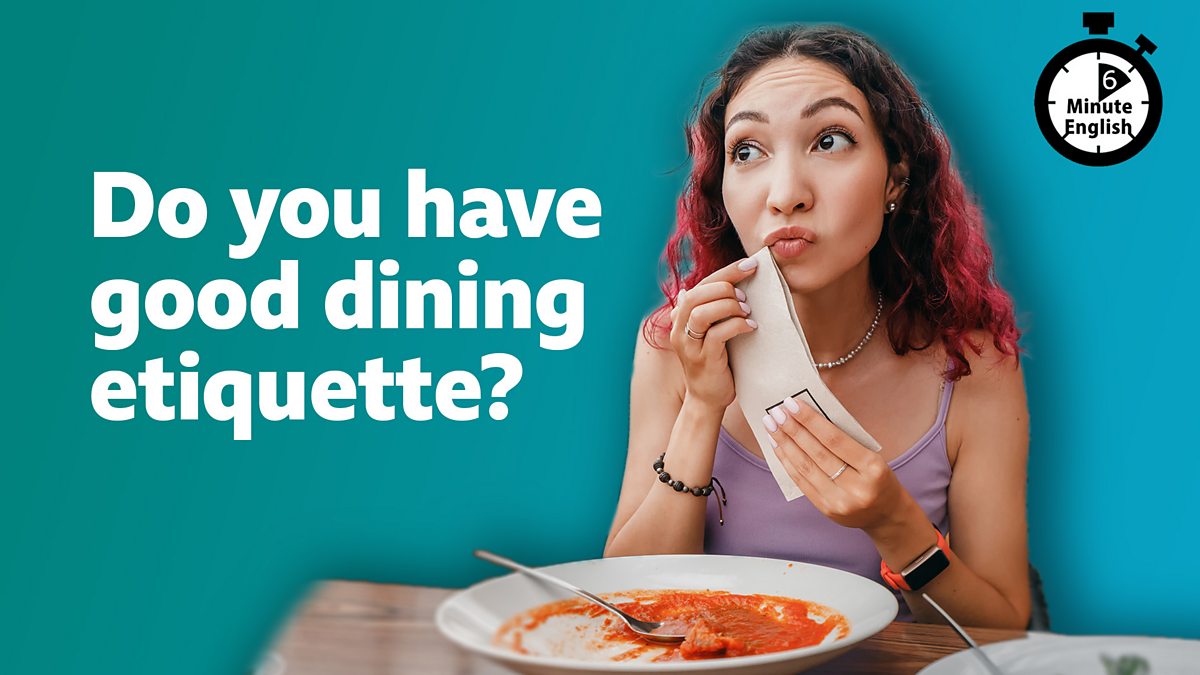
Hello, this is 6 Minute English from BBC Learning English. I'm Phil. PippaAnd I'm Pippa. In this episode, we're discussing etiquette the rules about what makes polite behaviour and in particular the dos and don'ts about what you should and shouldn't do when eating. So, Phil, what's the worst thing someone can do while eating, in your opinion? PhilFor me, it's being very noisy when you do it. I can't stand it. PippaMmm. OK. I don't have too many rules about eating, but I was always told growing up that you shouldn't have your elbows on the table and I never really understood why, but I always remember that one. So, we'll be hearing more about mealtime manners from some college students and an expert on British etiquette. And, as usual, we'll be learning some useful new words and phrases, all of which you can find on our website, bbclearningenglish.com. PhilBut first, I have a question for you, Pippa. Ideas about polite behaviour change a lot from country to country, so when BBC programme The Food Chain asked listeners from around the world about eating manners in their country, what do you think was the most common complaint? Was it: a) people eating with their hands,b) people eating noisily, orc) people burping at the table? PippaHmm. I don't think it's people eating with their hands, because lots of people around the world do that as, kind of, their normal way of eating, but maybe it's b) people eating noisily, I think. Like you mentioned, Phil, that's quite annoying. PhilWell, we'll find out the answer later in the programme. The Food Chain also interviewed students at London's City of Westminster College about family dinnertimes. Samuel is 19 and from Sierra Leone, and Aya is 18 and British but her family are from Iraq. Let's listen as they chat with BBC World Service's The Food Chain: SamuelYeah, I would say first impressions really do matter because it also is really important how you portray yourself how you present yourself to the person. AyaWhat I don't want to see is any loud chewing, or with your mouth open, please and thank you! I would like to see though eye contact, having a conversation, using your cutlery. Sometimes and I know this could be, like, picky for everyone else but having a tissue or napkin on your lap just in case you spill anything. PhilThe students think etiquette is important. Samuel says it's about making a good first impression. Your first impression is the opinion you form about someone when you meet them for the first time. PippaFor Aya, eating with your mouth open is definitely rude. She also thinks people should use a napkin, although that could be seen as picky. Picky here means being too strict about the rules. PhilFor this group of students, showing respect and appreciation for the meal is very important, and this idea is common across most, if not all, cultures throughout history. PippaSo, imagine a scene from a TV show like Game of Thrones: two enemy forces have stopped fighting, made peace and now gather for a meal. The leaders clink glasses, meaning they lift up and touch drinks, and make a toast they hold up a glass of alcohol and drink it to show respect. PhilNow, keep that image in mind because we're going to hear British etiquette coach Rupert Wesson explaining why people clink glasses. Here he is, talking to Ruth Alexander, presenter of BBC World Service programme The Food Chain: Rupert WessonPerhaps the simplest example is, "Why do we clink glasses when we have a toast?" If you clink glasses, you're slopping a bit of your drink into his cup and he's slopping a bit of drink into your cup. And therefore, by having that toast you are showing: "Look I trust you. You trust me." And that's why we do it. Ruth AlexanderIf you've poisoned my drink that's now slopped into your cup, you won't drink it. Rupert WessonCorrect. Ruth AlexanderHats at the table we're hearing from BBC World Service listeners that that is a no-no. Is that right? RupertIt's not something I would do. In fact, I would not be wearing a hat inside anyway. PippaSo, Phil, when we clink glasses in a toast, some of my drink might spill into your glass and some of your drink might spill into mine. Historically, this mixing of drinks was a way of proving the drinks were not poisoned. PhilRuth also asks about wearing hats at the table and Rupert calls this a no-no. A no-no is an informal phrase for something that is considered socially unacceptable. PippaEtiquette varies a lot over time and culture, but the essential point is always to show appreciation by doing some things and avoiding others. And speaking of things to avoid, what was the answer to your question, Phil? PhilOK. Well, I asked you what listeners of the food chain thought was the biggest etiquette problem when people are eating. You said that it was people eating noisily and I can reveal that's the right answer! It was people eating noisily. OK. Let's recap the vocabulary we've learned about mealtime dos and don'ts rules about how you should and shouldn't behave. PippaYour first impression of someone is the opinion you form when meeting them for the first time. PhilThe word picky is used to describe someone who is too strict about rules. PippaIf you clink glasses,you touch two drinking glasses together as a gesture of friendship, probably because you're making a toast a show of respect that involves drinking from a glass of alcohol. PhilAnd finally, a no-no is an informal word for something considered socially unacceptable. Once again, our six minutes are up, but if you'd like to find out more about dining etiquette then head over to our website, bbclearningenglish.com, to download a programme worksheet and try the quiz. See you again soon, but for now, it's goodbye! PippaBye!
Find an A-Z list of our programmes.
Try The Reading Room.
Beth and Neil talk about a strange emotion we can feel at Christmas called nostalgia
Would you know how to spot a Death Cap mushroom?
Could your next therapist be a horse?
Have you ever tried a crisp sandwich?
Do you follow politics on social media?
What's the worst thing someone can do while eating?
Now try this...
Practise your skills with more lessons from 6 Minute English.
Gratis selamanya · Akses penuh
Go to full course →This lesson includes:
- 🎧Audio lesson
- 📄Downloadable PDF
- 📝Full transcript
- ♾️Full access — free forever
Takeaways
Podcast
6 Minute EnglishLatest 6 Minute English
6 Minute English / Scared of speaking English?
Episode 260122 / 22 Jan 2026
Beth and Pippa talk about why we often find speaking a new language scary.
6 Minute English / Can AI solve crime?
Episode 250417 / 17 Apr 2025
Could artificial intelligence be used to solve a murder?
6 Minute English / Learning multiple languages
Episode 250410 / 10 Apr 2025
Is learning languages good for you?
6 Minute English / Are we getting more allergic to things?
Episode 250403 / 03 Apr 2025
Do you know anyone who has 50+ allergies?
6 Minute English / The country that measures happiness
Episode 250306 / 06 Mar 2025
Is happiness the key to success?
6 Minute English / Becoming a musician
Episode 250130 / 30 Jan 2025
Hear about life as a professional musician

6 Minute English / Is rejection good for us?
Episode 260917 / 17 Sep 2026
How do you feel about being rejected?

6 Minute English / Can apps teach you a language?
Episode 260910 / 10 Sep 2026
What's better for learning languages – an app or a class?

6 Minute English / Climate change and extreme weather
Episode 260903 / 03 Sep 2026
Every year we see damage, death and destruction caused by hurricanes, cyclones and typhoons - tropical storms. Is climate change making this impact worse?

6 Minute English / How do we describe smells?
Episode 260827 / 27 Aug 2026
What is your favourite smell?