6 Minute English
medium level6 Minute English / Finding and eating wild food
Transcript
Note: This is a transcript of a spoken conversation and is not a word-for-word script.
Note: This is not a word-for-word transcript.
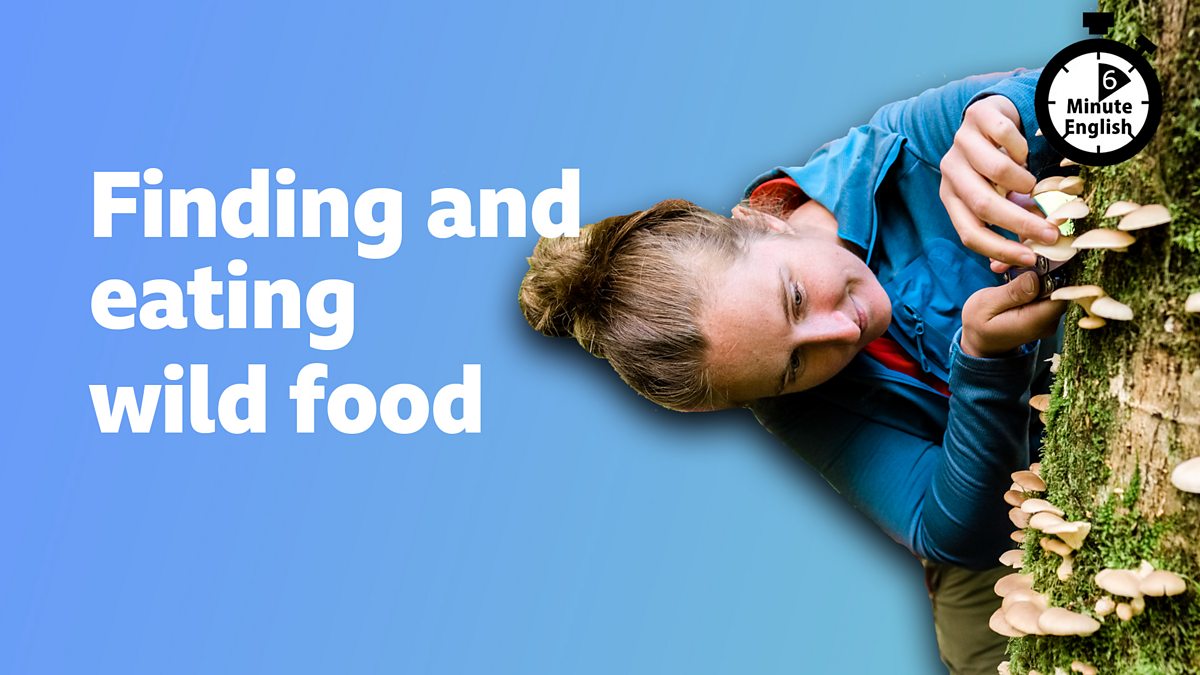
Hello, this is 6 Minute English from BBC Learning English. I'm Pippa. BethAnd I'm Beth. Foraging is the activity of walking in the countryside, looking for plants you can eat that grow in the wild. That's anything from blackberries and chestnuts to mushrooms and wild garlic. It's something humans have always done and recently it's become fashionable among groups of young people. Pippa, have you ever been foraging? PippaYes, we used to go and pick blackberries when I was younger, but I haven't really done it as an adult, and I would be a bit nervous to look for mushrooms or things like that. What about you? BethI'm exactly the same. If I see a blackberry on a bush, I will eat it! But mushrooms? No. Too scary. PippaSo, in this episode, we'll meet two young women from different countries who are passionate about foraging wild food. They're both self-taught, having learned to forage by studying the natural world around them, and it's important to say that they only eat what they can identify with one hundred percent certainty, sticking to the rule, "If in doubt leave it out!" BethWe'll also be learning some useful new words and phrases, all of which you'll find on our website, bbclearningenglish.com. But before that, I have a question for you, Pippa. As mentioned, when foraging you must know for certain what is safe to eat. Something definitely not safe to eat is the mushroom Death Cap. As the name suggests, it's one of the world's deadliest mushrooms, and it's common across the British Isles, but what colour is it? Are Death Cap mushrooms: a) brown,b) white, orc) red? PippaI'm going to say, if it's dangerous maybe it's red. BethOK. Well, we'll find out later in the programme. First, let's meet Roushanna Gray, a wild-food forager living in Cape Point, South Africa. Roushanna learned how to forage from her mother-in-law, as she explains here to BBC World Service programme The Conversation: Roushanna GraySo, she is a horticulturalist. She has a deep knowledge of plants. And so, I would be, kind of, scanning the landscape and learning about these new plants or new to me and wondering if you could eat them. Something that's incredibly important in foraging is to know a hundred and ten percent if you can eat it positive identification of the plant. And so, she was my plant person. PippaRoushanna's mother-in-law is a horticulturalist a person who studies or grows plants such as flowers, fruits and vegetables. She has a deep knowledge of the wild plants growing in nature. A deep knowledge means a thorough understanding of a subject gained from experience and study, not just knowing the basic facts. BethOne skill foragers need is scanning the landscape. Scanning means searching a wide area with your eyes to find some particular thing in this case, edible plants and herbs. PippaAnd of course, Roushanna only eats plants that she can positively identify plants that she knows a hundred and ten percent are safe to eat. Here, the idiom a hundred and ten percent means Roushanna is completely sure. She has no doubt. And that's important, as the consequences of eating poisonous plants are serious sickness or even death.BethOur second female forager, Emily Smith, moved to rural Japan to work on a project cataloguing and collecting wild mushrooms. With around 5,000 varieties, 300 of which are edible, mushrooms are an important part of traditional Japanese cooking. But with names like Death Cap and a reputation for being poisonous, mushrooms are what many wild foragers worry about the most. Emily discussed these worries with BBC World Service programme The Conversation. Emily SmithThat stigma is a bit misplaced, I think, because plants can be just as dangerous, if not more dangerous than mushrooms, and I think that mushrooms have been much maligned. I mean, you've got to exercise caution, as Roushanna said, in anything that you pick. You need to know what it is before you consume it. "If in doubt, throw it out!" is a very good phrase to say. PippaEmily thinks there's a stigma around mushrooms. A stigma is a negative belief about something which is not necessarily true or fair. In fact, many plants are just as poisonous as mushrooms. BethThe main thing is to exercise caution to act with care and attention so as to avoid possible dangers. In other words, to be careful. PippaAnd the best way of doing that is learning the difference between what's safe to eat and what's not. Speaking of which, what was the answer to your question, Beth? BethAh! I asked you, "What colour are Death Cap mushrooms?" You said red, which I also thought was the answer, but actually they are white. Right, it's time to recap the vocabulary we've learnt about foraging, starting with horticulturalist a person who studies or grows plants. PippaIf you have a deep knowledge of a subject, you have a thorough understanding of it, gained from experience and study. BethScanning involves searching a wide area with your eyes to find some particular thing. PippaIf you're a hundred and ten percent sure about something, you're absolutely certain. You have no doubt. BethA stigma is an unfair, negative belief about something. PippaAnd finally, to exercise caution is a more formal way of saying to be careful something you should definitely remember if you go wild foraging yourself! Once again, our six minutes are up. If you enjoyed this episode, you'll find a quiz and worksheet to practise the vocabulary on our website, bbclearningenglish.com. See you again soon. Bye for now! BethGoodbye!
Find an A-Z list of our programmes.
To learn English from news headlines, listen to Learning English from the News.
Try The Reading Room.
Beth and Neil talk about a strange emotion we can feel at Christmas called nostalgia
Would you know how to spot a Death Cap mushroom?
Could your next therapist be a horse?
Have you ever tried a crisp sandwich?
Do you follow politics on social media?
Now try this...
Practise your skills with more lessons from 6 Minute English.
Gratis selamanya · Akses penuh
Go to full course →This lesson includes:
- 🎧Audio lesson
- 📄Downloadable PDF
- 📝Full transcript
- ♾️Full access — free forever
Takeaways
Podcast
6 Minute EnglishLatest 6 Minute English
6 Minute English / Scared of speaking English?
Episode 260122 / 22 Jan 2026
Beth and Pippa talk about why we often find speaking a new language scary.

6 Minute English / Can AI solve crime?
Episode 250417 / 17 Apr 2025
Could artificial intelligence be used to solve a murder?

6 Minute English / Learning multiple languages
Episode 250410 / 10 Apr 2025
Is learning languages good for you?
6 Minute English / Are we getting more allergic to things?
Episode 250403 / 03 Apr 2025
Do you know anyone who has 50+ allergies?

6 Minute English / The country that measures happiness
Episode 250306 / 06 Mar 2025
Is happiness the key to success?

6 Minute English / Becoming a musician
Episode 250130 / 30 Jan 2025
Hear about life as a professional musician

6 Minute English / Is rejection good for us?
Episode 260917 / 17 Sep 2026
How do you feel about being rejected?

6 Minute English / Can apps teach you a language?
Episode 260910 / 10 Sep 2026
What's better for learning languages – an app or a class?

6 Minute English / Climate change and extreme weather
Episode 260903 / 03 Sep 2026
Every year we see damage, death and destruction caused by hurricanes, cyclones and typhoons - tropical storms. Is climate change making this impact worse?

6 Minute English / How do we describe smells?
Episode 260827 / 27 Aug 2026
What is your favourite smell?