6 Minute English
medium level6 Minute English / How culture affects sadness
Transcript
Note: This is a transcript of a spoken conversation and is not a word-for-word script.
Note: This is not a word-for-word transcript.
Hello. This is 6 Minute English from BBC Learning English. I m Sam.
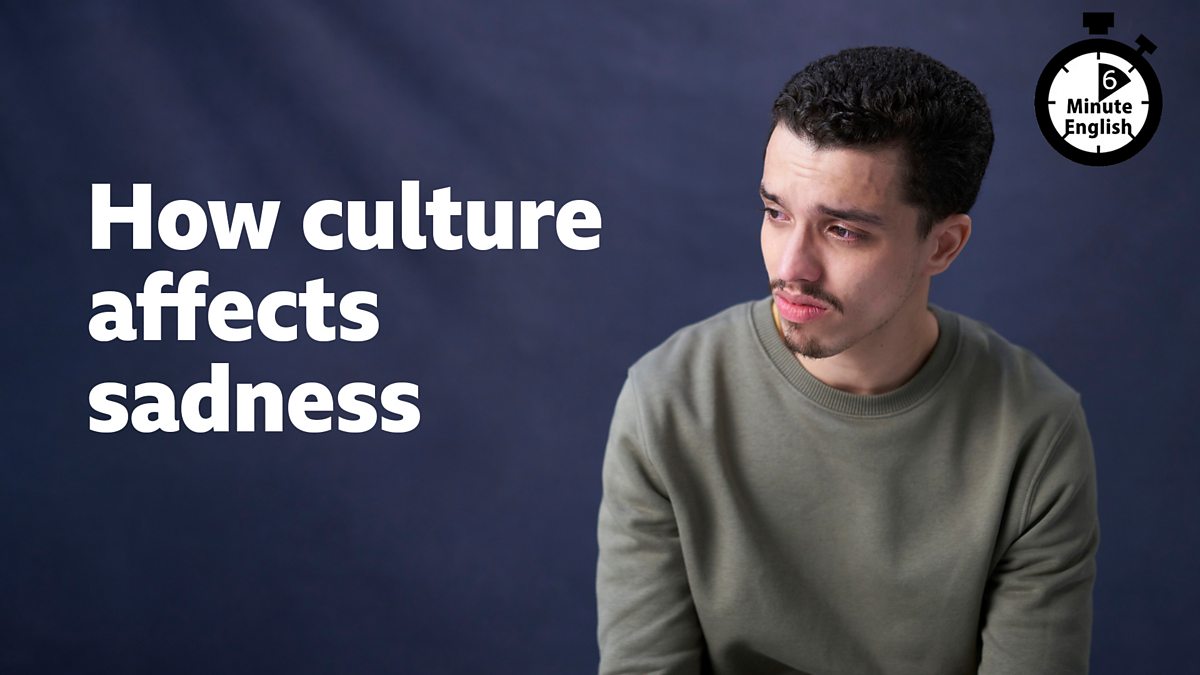
And I m Neil. When Helen Russell was three years old, her new-born baby sister died suddenly. Looking back at that sad time, Helen remembers making a big decision she wanted to be happy. She became a bestselling author and wrote a book called, The Atlas of Happiness. She got married, and even moved to the famously happy city of Copenhagen in Denmark.
But the sadness Helen felt didn t disappear, and the longer she lived abroad, the more she wondered whether her feelings were somehow connected to being born in England, into a culture where, traditionally, expressing your emotions was discouraged.
In this programme, we ll be investigating how the way people express sadness is influenced by their culture, and, as usual, we ll be learning some new, useful vocabulary as well.
But first I have a question for you, Neil. In English there are many idioms which describe being sad, including down in the dumps, meaning that you feel miserable and depressed. Also, emotions are often associated with colours, for example you might go red with anger, or turn green with envy. But which colour is associated with sadness? Is it:
a) yellow?b) blue? or,c) brown?
I think the answer is blue.
OK, Neil. We ll find out the later in the programme. Around the world, cultures express emotions very differently. In Spain, flamenco performers express their emotions with colourful displays of song and dance, whereas in Japan, crying is considered weak and shameful. To discover more about how British people express their feelings, Helen Russell interviewed, Thomas Dixon, a professor at the Centre for the History of Emotion, for BBC World Service programme, The Documentary:
Professor Thomas DixonThe word sad, as you will know, Helen, literally means sated or full. So, it s earliest use is in English, it means being literally fed up, being full of something sad or sated means heavy and full. And then of course we have this huge vocabulary of melancholy, sorrow, grief, depression and many, many other terms, and they all mean slightly different things.
Now try this...
Practise your skills with more lessons from 6 Minute English.
Gratis selamanya · Akses penuh
Go to full course →This lesson includes:
- 🎧Audio lesson
- 📄Downloadable PDF
- 📝Full transcript
- ♾️Full access — free forever
Takeaways
Podcast
6 Minute EnglishLatest 6 Minute English
6 Minute English / Scared of speaking English?
Episode 260122 / 22 Jan 2026
Beth and Pippa talk about why we often find speaking a new language scary.
6 Minute English / Can AI solve crime?
Episode 250417 / 17 Apr 2025
Could artificial intelligence be used to solve a murder?
6 Minute English / Learning multiple languages
Episode 250410 / 10 Apr 2025
Is learning languages good for you?
6 Minute English / Are we getting more allergic to things?
Episode 250403 / 03 Apr 2025
Do you know anyone who has 50+ allergies?
6 Minute English / The country that measures happiness
Episode 250306 / 06 Mar 2025
Is happiness the key to success?
6 Minute English / Becoming a musician
Episode 250130 / 30 Jan 2025
Hear about life as a professional musician

6 Minute English / Is rejection good for us?
Episode 260917 / 17 Sep 2026
How do you feel about being rejected?

6 Minute English / Can apps teach you a language?
Episode 260910 / 10 Sep 2026
What's better for learning languages – an app or a class?

6 Minute English / Climate change and extreme weather
Episode 260903 / 03 Sep 2026
Every year we see damage, death and destruction caused by hurricanes, cyclones and typhoons - tropical storms. Is climate change making this impact worse?

6 Minute English / How do we describe smells?
Episode 260827 / 27 Aug 2026
What is your favourite smell?