6 Minute English
medium level6 Minute English / How do we adapt to the cold?
Transcript
Note: This is a transcript of a spoken conversation and is not a word-for-word script.
Note: This is not a word-for-word transcript.
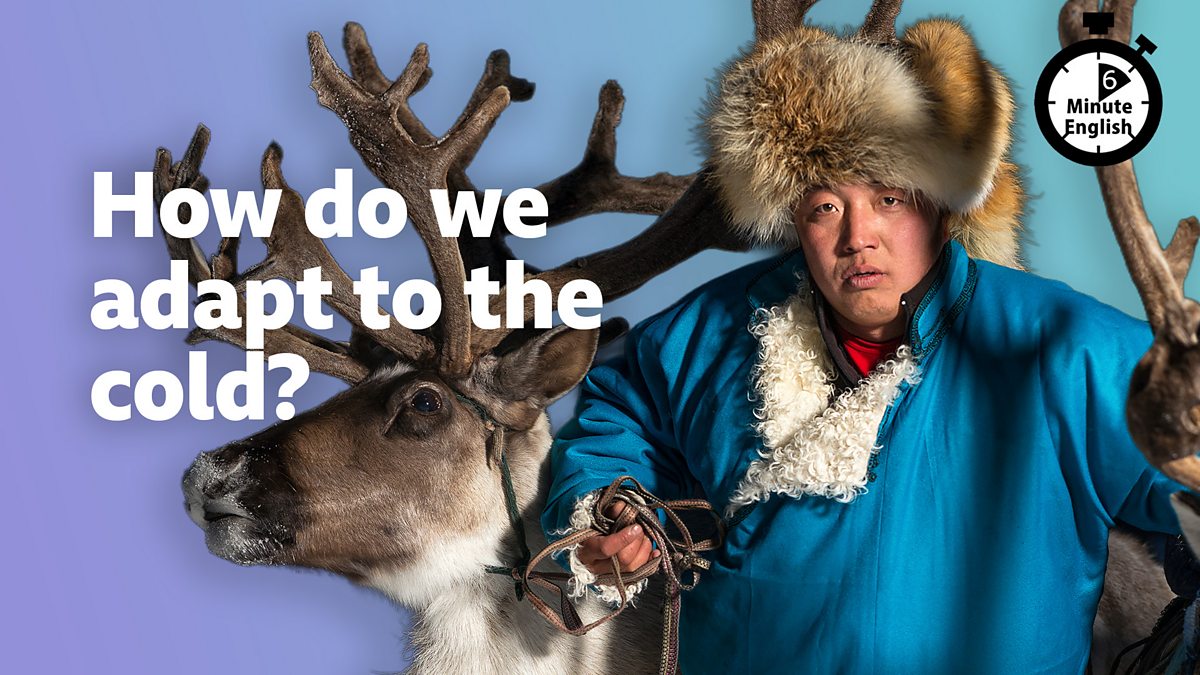
Hello, this is 6 Minute English from BBC Learning English. I'm Phil. BeccaAnd I'm Becca. 6-Minute-English listeners are truly global, coming from all over the world, including some of the coldest countries on Earth places like Finland, where winter temperatures drop to -20 C. Are you good at dealing with the cold, Phil? PhilI'm not sure, but I do know that I don't like it. What about you, Becca? BeccaWell, I'd rather be too hot and cool down than too cold and try to warm up. PhilYes, me too. Here in the UK, it never gets as cold as Finland, but it's not unusual to see some people dressed in T-shirts while others are wrapped up in warm clothes. Why do people feel the cold so differently? That's what we'll be discussing in this episode, as well as learning some useful new words and phrases. BeccaAnd as always, you'll find all the vocabulary from this episode, plus a quiz and worksheet, on our website, bbclearningenglish.com. PhilBut now I have a question for you, Becca. According to the Guinness Book of World Records, the lowest temperature ever recorded was a very cold -89 C... but where? Was it:a) the Arctic,b) Antarctica, orc) the top of Mount Everest? BeccaHmm. I'm going to guess b) Antarctica. PhilOK. Well, we'll find out the answer at the end of the programme. Our experience of cold depends on many things, including our genes, culture and place of birth, but perhaps the most obvious thing is the clothes we wear. Professor Gunhild S tren lives on the icy island of Svalbard, 800 miles inside the Arctic Circle. Here, she advises presenter Caroline Steel on how to dress against the cold, for BBC World Service programme CrowdScience. Caroline SteelSo, what should we consider when choosing our clothes? Gunhild S trenFirst and foremost, I would say that perhaps the gender differs. So, males often are more tolerant, perhaps, than females. Then it's of course what you're used to. Are you used to dealing with the cold? Are you not? BeccaGunhild says that first and foremost, men and women feel the cold differently. She uses the phrase first and foremost to mean 'more than anything else'. She wants to emphasise that something in this case, someone's gender is the most important thing to consider. PhilThere is some debate about whether men or women are more tolerant of the cold. Being tolerant of something means being able to endure it without getting hurt. BeccaAnother important factor is whether you are used to the cold if being in cold environments is something you're familiar with. PhilIt might sound obvious that someone born in Arctic Svalbard would feel less cold than someone born in Brazil, but apart from environmental factors, are there actual physical differences that allow people to cope better with the cold? BeccaDr Cara Ocobock studies reindeer herders in northern Finland people who live in cold temperatures every day and have done for centuries. She measures their reaction to extreme cold and compares it to ordinary Finns from warmer parts of the country. Here, Cara shares her findings with Caroline Steel from BBC World Service's CrowdScience. Caroline SteelOK. My guess is the reindeer herders deal better in the cold. Dr Cara OcobockYes and no. The more data we collect within this area, the more confusing the picture gets. I can say that subjectively, at this point, the reindeer herders, at least kind of mentally, handle the cold far better. They are far less likely to shiver. PhilSo, do the reindeer herders deal better with the cold? The answer is yes and no a phrase meaning partly and partly not, used when there's no clear answer to a question. However, Cara does say subjectively, the herders manage better. They don't feel so cold. Subjectively means based on your personal inner experience rather than objective facts. BeccaAnd physically there are differences too. Reindeer herders are less likely to shiver the shaky movement that cold muscles make to try and warm them up. In fact, how we experience the cold is probably a combination of everything we've discussed, including genetic adaptations passed on from parents to children. Right, I'm off to find my gloves and woolly hat, so why don't you reveal the answer to the question, Phil? PhilYes, I asked where the lowest temperature on Earth was ever recorded. You said b) Antarctica. And that is... the right answer. The lowest temperature ever recorded on Earth was at the Vostok Research Station in Antarctica in 1983. Let's recap the vocabulary we've learned, starting with the phrase first and foremost, meaning more than anything else.BeccaA person who is tolerant of something is able to endure it without being hurt. PhilIf you're used to something, you're familiar with it. BeccaThe idiom yes and no means partly and partly not, and is used when you can't give a clear answer to a question. PhilThe adverb subjectively means in a way that's based on your personal experience rather than objective facts. BeccaAnd finally, a shiver is the shaking movement made by your muscles when you feel cold or afraid. Once again, our six minutes are up, but remember you'll find a quiz and a worksheet for this episode on our website, bbclearningenglish.com. See you there soon, but for now, it's goodbye. PhilBye!
Find an A-Z list of our programmes.
To learn English from news headlines, listen to Learning English from the News.
Practise your reading skills with The Reading Room.
How do you feel about being rejected?
What's better for learning languages – an app or a class?
Every year we see damage, death and destruction caused by hurricanes, cyclones and typhoons - tropical storms. Is climate change making this impact worse?
What is your favourite smell?
Would you trust a robot to drive you around a city?
Now try this...
Practise your skills with more lessons from 6 Minute English.
Gratis selamanya · Akses penuh
Go to full course →This lesson includes:
- 🎧Audio lesson
- 📄Downloadable PDF
- 📝Full transcript
- ♾️Full access — free forever
Takeaways
Podcast
6 Minute EnglishLatest 6 Minute English
6 Minute English / Scared of speaking English?
Episode 260122 / 22 Jan 2026
Beth and Pippa talk about why we often find speaking a new language scary.

6 Minute English / Can AI solve crime?
Episode 250417 / 17 Apr 2025
Could artificial intelligence be used to solve a murder?

6 Minute English / Learning multiple languages
Episode 250410 / 10 Apr 2025
Is learning languages good for you?

6 Minute English / Are we getting more allergic to things?
Episode 250403 / 03 Apr 2025
Do you know anyone who has 50+ allergies?

6 Minute English / The country that measures happiness
Episode 250306 / 06 Mar 2025
Is happiness the key to success?
6 Minute English / Becoming a musician
Episode 250130 / 30 Jan 2025
Hear about life as a professional musician

6 Minute English / Is rejection good for us?
Episode 260917 / 17 Sep 2026
How do you feel about being rejected?

6 Minute English / Can apps teach you a language?
Episode 260910 / 10 Sep 2026
What's better for learning languages – an app or a class?

6 Minute English / Climate change and extreme weather
Episode 260903 / 03 Sep 2026
Every year we see damage, death and destruction caused by hurricanes, cyclones and typhoons - tropical storms. Is climate change making this impact worse?

6 Minute English / How do we describe smells?
Episode 260827 / 27 Aug 2026
What is your favourite smell?