6 Minute English
medium level6 Minute English / How do you say sorry?
Transcript
Note: This is a transcript of a spoken conversation and is not a word-for-word script.
Note: This is not a word-for-word transcript.
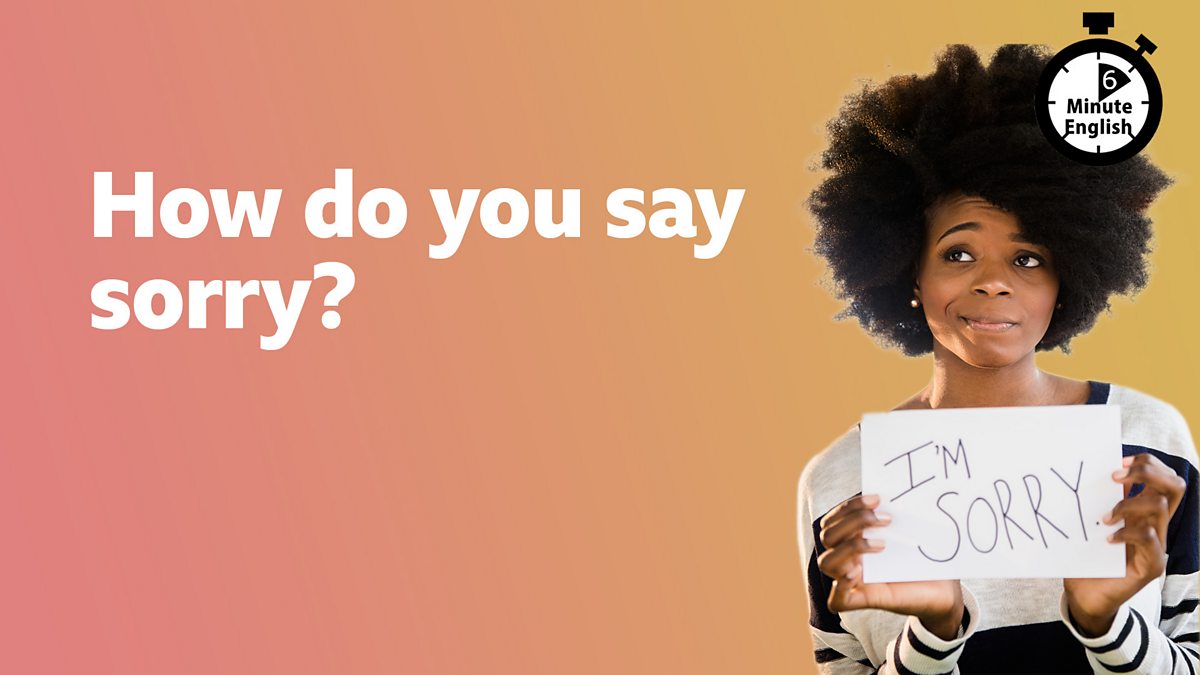
Hello, this is 6 Minute English from BBC Learning English. I'm Neil. BethAnd I'm Beth. NeilIn English there are many ways to apologise, depending on the situation. In formal situations you could say, "Please forgive me," while to a friend you might say, "My bad." And of course there's the most common phrase of all: "I'm sorry." Can you remember a time when you had to apologise, Beth? BethErm Oh, I had to apologise this morning because I stepped on someone's toes on the tube. NeilOK. Well, apologising depends on what you've done, so 'sorry' is fine if you accidentally step on someone's toes, like you did this morning, Beth. But what if you do something really serious, like the Ghanaian journalist, Afia Pokua, who publicly criticised the King of the Ashanti tribe? Here's BBC World Service programme, The Fifth Floor, covering the story: Faranak Amidi I guess it's not every day that you end up offending a king, but let's say you did. Would you know how to apologise to him? Recently in Ghana, a journalist made some comments on television about the King of the Ashanti tribe, and soon she found herself at his palace apologising. BethThe presenter says, "It's not every day that you offend a king." The phrase, it's not every day that, highlights that what's happened is very unusual. So, how do apologies change from culture to culture? Well, that's what we'll be finding out in this episode, along with some useful new words and phrases. NeilAnd remember, you'll find all the vocabulary from this episode on our website, bbclearningenglish.com. Now, I have a question for you, Beth. We know that people from different countries apologise in different ways, but what might someone do to say sorry if they were from India? Would they: a) offer a gift,b) pull their earlobes, orc) bow down? BethOoh, I am going to guess c) bow down. NeilOK. Well, we'll find out if you're right at the end of the programme. Let's return to Afia Pokua, the journalist who criticised the King of the Ashanti tribe. Her comments divided opinion in Ghana, but eventually Afia decided to say sorry to the King, following strict traditional rules, that she dress in black and apologise kneeling down on her knees. BethAfia's story shows the influence of culture on how people say sorry. Let's listen now as three BBC journalists from different countries explain to World Service programme, The Fifth Floor, how to say sorry in their culture: Ahsan MahmoodI would say that Pakistanis generally they're not really expressive, and we're also very cheeky so what we generally do is we would slide an apology in the middle of a conversation, and then very quickly move on to a new topic so that we don't have to, sort of, be very upfront about it. Liza FokhtIn Russia, we also have a tradition called Forgiveness Sunday, which happens on the last Sunday before Easter. The tradition is that you call your family and friends and apologise for any sorrows you've caused. Son Hun WeIn Korea, the way of saying sorry varies depending on the relationship between the speaker and the listener, due to the complex honorific system in the language. In many cases we say, "Che song ham ni da." This is used in formal situations or with people we don't know well, and we often bow when saying, "Che song ham ni da." NeilJournalist Ahsan Mahmood thinks apologising in Pakistan is different because people are not expressive they don't usually show what they think or feel. Rather, he says, Pakistanis tend to be cheeky, an adjective meaning slightly rude but in a funny, playful way. BethIn Pakistan, people sometimes avoid being upfront about what they've done. If you're upfront about something, you speak openly about it, so everyone knows your feelings and intentions. NeilMoving now to Russia, the journalist Liza Fokht describes a tradition called Forgiveness Sunday, when people apologise to friends and family for sorrows they have caused. Sorrows are sources of sadness or regret. BethAnd finally, in Korea, how you say sorry depends on who you're apologising to. Korea has a complicated honorific system dictating how people above you in the social order should be addressed. Honorific means showing respect and honour to someone. NeilWell, there's a saying that 'sorry is the hardest word', but who knew there were so many ways to say it! BethYes. And it's not just words if you're really sorry, you dosomething to make things right, like giving a small gift. So, Neil, what do people in India do? What's the answer to your question? NeilYes. Well, I asked what people in India do to apologise, and what answer did you give me, Beth? BethI said bow down. Is that right? NeilI'm afraid that was the wrong answer you should apologise to me for that. It is in fact b) in India, it's common to tug your ear lobes when apologising. OK. Let's recap the vocabulary we've learned, starting with the idiom, it's not every day that, which is used to say that something is very unusual. BethAn expressive person shows what they think or feel. NeilThe adjective cheeky means slightly rude in a funny, playful way. BethWhen you are upfront about something, you speak openly and clearly so people know your true intentions. NeilSorrows are sources of sadness or regret. BethAnd finally, the adjective honorific means showing respect and honour to someone. Well, I'm sorry to say that once again our six minutes are up, but if you are ready for more, just head over to our website bbclearningenglish.com for a quiz and a worksheet for this episode. Bye for now! NeilGoodbye.
Beth and Neil talk about a strange emotion we can feel at Christmas called nostalgia
Would you know how to spot a Death Cap mushroom?
Could your next therapist be a horse?
Have you ever tried a crisp sandwich?
Do you follow politics on social media?
What's the worst thing someone can do while eating?
Would you ever consider playing in a bomb site?
Have you ever had garlic breath?
Now try this...
Practise your skills with more lessons from 6 Minute English.
Gratis selamanya · Akses penuh
Go to full course →This lesson includes:
- 🎧Audio lesson
- 📄Downloadable PDF
- 📝Full transcript
- ♾️Full access — free forever
Takeaways
Podcast
6 Minute EnglishLatest 6 Minute English
6 Minute English / Scared of speaking English?
Episode 260122 / 22 Jan 2026
Beth and Pippa talk about why we often find speaking a new language scary.

6 Minute English / Can AI solve crime?
Episode 250417 / 17 Apr 2025
Could artificial intelligence be used to solve a murder?

6 Minute English / Learning multiple languages
Episode 250410 / 10 Apr 2025
Is learning languages good for you?
6 Minute English / Are we getting more allergic to things?
Episode 250403 / 03 Apr 2025
Do you know anyone who has 50+ allergies?

6 Minute English / The country that measures happiness
Episode 250306 / 06 Mar 2025
Is happiness the key to success?
6 Minute English / Becoming a musician
Episode 250130 / 30 Jan 2025
Hear about life as a professional musician

6 Minute English / Is rejection good for us?
Episode 260917 / 17 Sep 2026
How do you feel about being rejected?

6 Minute English / Can apps teach you a language?
Episode 260910 / 10 Sep 2026
What's better for learning languages – an app or a class?

6 Minute English / Climate change and extreme weather
Episode 260903 / 03 Sep 2026
Every year we see damage, death and destruction caused by hurricanes, cyclones and typhoons - tropical storms. Is climate change making this impact worse?

6 Minute English / How do we describe smells?
Episode 260827 / 27 Aug 2026
What is your favourite smell?