6 Minute English
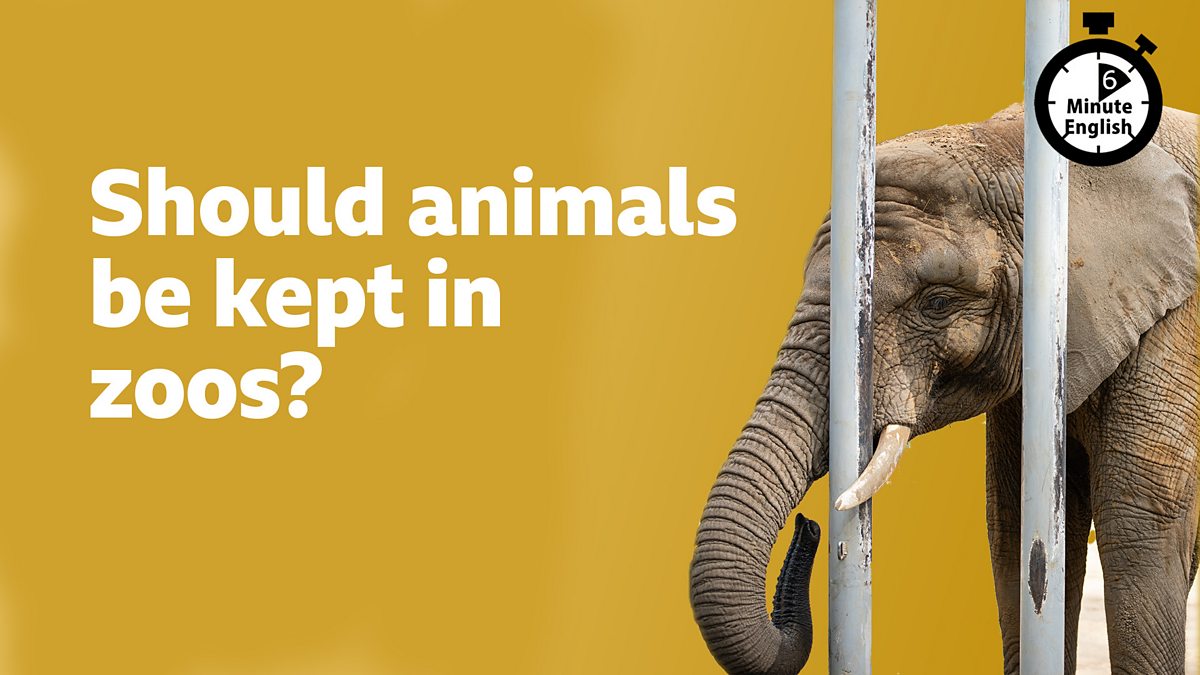
medium level6 Minute English / Should animals be kept in zoos?
Transcript
Note: This is a transcript of a spoken conversation and is not a word-for-word script.
Note: This is not a word-for-word transcript.
Hello. This is 6 Minute English from BBC Learning English. I'm Neil. GeorgieAnd I'm Georgie. In this programme we're discussing a controversial topic that often produces strong feelings: should animals be kept in zoos? What's your opinion on this debate, Neil? NeilOh, it's a really difficult question, Georgie. I think there are good scientific reasons for having animals in zoos, but also, it seems to me a little bit sad and cruel for wild animals to be locked up. GeorgieFor some, zoos are a good way to teach people about nature and save endangered species from extinction. Others think separating animals from their natural habitat is cruel and unnecessary. Either way, with an estimated 700 million visitors every year, zoos remain popular but are they a good thing? We'll be debating the pros and cons, as well as learning some useful new words and phrases. NeilAnd remember you can find all the vocabulary for this programme on our website, bbclearningenglish.com. Now, I have a question for you, Georgie. In 2022, five animals escaped from Sydney's Taronga Zoo in Australia, but were the escaped animals: a) elephantsb) lionsc) zebras GeorgieHmm. I can imagine zebras running away from the zoo.
OK. We'll find out the answer at the end of the programme. Reporter William Lee Adams has been investigating the arguments for and against keeping animals in zoos with BBC World Service programme, What in the World. Here he gives two arguments in favour of zoos: William Lee AdamsEducation is the primary reason that zoos give for why they should exist. The fact is school children all over the world are often bussed to zoos. I remember myself going to see lowland gorillas at Zoo Atlanta every single year, and the point of this was to introduce us to conservation. GeorgieOne argument for keeping animals in zoos is to educate people about the importance of conservation: the protection of plants, animals and the natural world from human damage. William Lee AdamsA second point is that zoos often invest in research programmes that help endangered animals. Now as we know, pandas are notoriously reluctant to mate: the female pandas have a narrow window of fertility, they're solitary creatures and it takes two to tango when it comes to reproduction. But a lot of money in zoos it goes to, sort of, find ways to encourage these animals to mate. NeilA second argument is that zoos protect endangered species from extinction through breeding. William mentions pandas, animals which are reluctant, meaning slow and unwilling, to reproduce. Male and female pandas need a little help to make babies, and zoos can provide this help. William uses the idiom, it takes two to tango, to describe an activity which needs two people, or in this case two pandas, to be willing to make something a success. GeorgieNow, let's turn to some of the arguments against zoos with Nikita Dhawan, a 19-year-old animal-rights activist from India, who spoke to BBC World Service programme, What in the World: Nikita DhawanI don't think zoos should exist for several reasons, the first one being zoos' detrimental impact on both the physical and psychological health of animals. Many studies and research have shown that many animals in zoos and aquariums display abnormal behaviours like head-bobbing, pacing, stereotypical behaviours, signs of mental distress. The second reason, I would say, is that zoos cannot mimic the natural habitat of animals in the wild. NeilNikita argues that being enclosed in a zoo is so stressful for wild animals it leads to abnormal behaviour: behaviour that is different, and worse, from what would normally be expected. Examples of this include animals pacing their cages in circles and rocking, bar-biting, and even self-harm. And they're so common in captive animals, there's a name for it: zoochosis. GeorgieEven zoos with large enclosures cannot fully mimic, or copy, the natural habitats and open spaces these animals would enjoy in the wild. And imagine how a polar bear, evolved for life in the frozen Arctic, would feel, trapped in a zoo in a much warmer country. NeilSome zoologists have compared zoochosis to human traumas like post-traumatic stress disorder but say it's even more damaging. For captive animals, everything including the air they breathe is traumatic. GeorgieWe've heard a few arguments for and against keeping animals in zoos. What do you think, Neil? Have you changed your opinion at all? NeilWell, I think there are really strong arguments on both sides, so I'm still not sure, Georgie. GeorgieWell, we know how some of the animals at the Sydney Zoo felt about things because they managed to escape! But what was the answer to your question, Neil? NeilWell, Georgie, I asked you which animals escaped from a zoo in Sydney, Australia, in 2022. Was it a) elephants, b) lions, or c) zebras? GeorgieAnd I said zebras. NeilI'm afraid that was the wrong answer. It was actually lions how scary! OK. It's time to recap the vocabulary we've learned. Conservation is the protection of plants, animals and the natural world from human harm. GeorgieIf you are reluctant to do something, you don't want to do it, or you do it very slowly. NeilThe idiom, it takes two to tango, refers to an activity which needs two people to willingly and actively take part for it to succeed. GeorgieThe adjective, abnormal, means different from what would normally be expected, in a bad way. NeilZoochosis is a term to describe the repeated, purposeless behaviour performed by captive animals in response to the stress of being confined, including pacing, head-bobbing and swaying. GeorgieAnd finally, if you mimic somebody or something, you imitate it or copy it. Once again, our six minutes are up, but don't forget we have a worksheet and a quiz that you can use to practise the vocabulary from this episode. Visit bbclearningenglish.com. Goodbye for now. NeilGoodbye.
Beth and Neil talk about a strange emotion we can feel at Christmas called nostalgia
Would you know how to spot a Death Cap mushroom?
Could your next therapist be a horse?
Have you ever tried a crisp sandwich?
Do you follow politics on social media?
What's the worst thing someone can do while eating?
Would you ever consider playing in a bomb site?
Now try this...
Practise your skills with more lessons from 6 Minute English.
Gratis selamanya · Akses penuh
Go to full course →This lesson includes:
- 🎧Audio lesson
- 📄Downloadable PDF
- 📝Full transcript
- ♾️Full access — free forever
Takeaways
Podcast
6 Minute EnglishLatest 6 Minute English
6 Minute English / Scared of speaking English?
Episode 260122 / 22 Jan 2026
Beth and Pippa talk about why we often find speaking a new language scary.
6 Minute English / Can AI solve crime?
Episode 250417 / 17 Apr 2025
Could artificial intelligence be used to solve a murder?

6 Minute English / Learning multiple languages
Episode 250410 / 10 Apr 2025
Is learning languages good for you?
6 Minute English / Are we getting more allergic to things?
Episode 250403 / 03 Apr 2025
Do you know anyone who has 50+ allergies?
6 Minute English / The country that measures happiness
Episode 250306 / 06 Mar 2025
Is happiness the key to success?
6 Minute English / Becoming a musician
Episode 250130 / 30 Jan 2025
Hear about life as a professional musician

6 Minute English / Is rejection good for us?
Episode 260917 / 17 Sep 2026
How do you feel about being rejected?

6 Minute English / Can apps teach you a language?
Episode 260910 / 10 Sep 2026
What's better for learning languages – an app or a class?

6 Minute English / Climate change and extreme weather
Episode 260903 / 03 Sep 2026
Every year we see damage, death and destruction caused by hurricanes, cyclones and typhoons - tropical storms. Is climate change making this impact worse?

6 Minute English / How do we describe smells?
Episode 260827 / 27 Aug 2026
What is your favourite smell?