6 Minute English
medium level6 Minute English / The power of pepper
Transcript
Note: This is a transcript of a spoken conversation and is not a word-for-word script.
Note: This is not a word-for-word transcript.
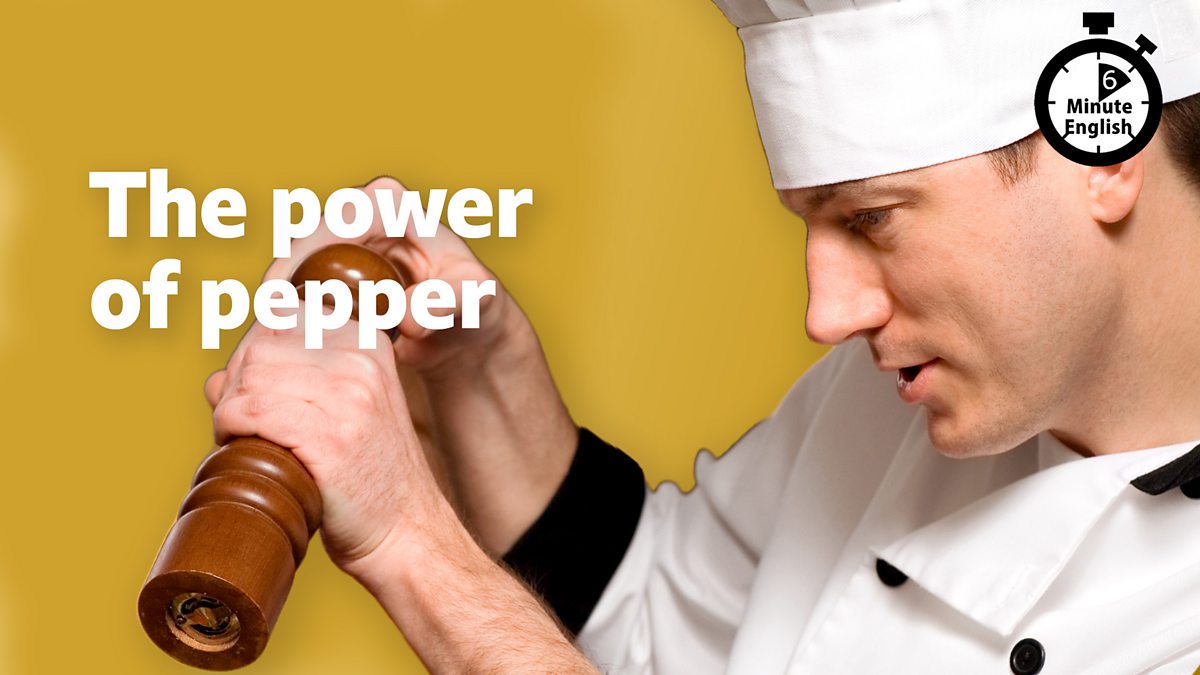
Hello. This is 6 Minute English from BBC Learning English. I'm Neil. BeccaAnd I'm Becca. NeilIn this episode, we're discussing a food seasoning that's so popular we eat around three quarters of a million tonnes of it a year. We're talking about pepper. Do you add pepper to your food, Becca? BeccaI do, Neil, yes. I think it's an easy way to add some spice. NeilYeah, I love a bit of pepper. I grind pepper onto everything. Well... not everything! But I do like it. Given its popularity, it's surprising that most people know very little about pepper. Did you know, for example, that peppers are the fruit of vines often growing over ten metres high? BeccaOur ancestors would be surprised how little we know. From ancient Greece onwards, pepper was prized as the black gold of ingredients, and explorers crossed oceans in search of it, discovering new continents along the way. In this episode, we'll get reacquainted with pepper and learn some useful new words and phrases too. And remember, you'll find a transcript for you to read along with us as you listen, on our website, bbclearningenglish.com. NeilOK. First, I have a question for you, of course, Becca. Although it's black pepper you're most likely to see in shops and restaurants in the UK, there are hundreds of different varieties worldwide. But what is unusual about Phu Quoc, a white pepper from Vietnam? Does it: a) make people cry,b) taste like parmesan cheese, orc) cost more than gold? BeccaHmm. Well, I don't think it would be as expensive as gold, and I kind of want it to taste like parmesan cheese. NeilOK. Well, we'll find out later in the programme. Mathilde Roellinger is the daughter of Olivier Roellinger, an award-winning French chef famous for his use of spices. While other little girls of her age were sprinkling sugar on their breakfast yoghurt, Mathilde was the only girl in Paris sprinkling pepper. Today, Mathilde runs the pices Roellinger spice shop in the Op ra area of the city. Here, customers can find a huge range of peppers, from fruity red Cambodian Kampot pepper to Borneo's Sarawak black pepper with its woody aroma. BeccaThese peppers have strong, distinctive tastes, but curiously they enhance rather than overpower the flavour of the food you're eating, as Mathilde explained to BBC World Service programme The Food Chain. Mathilde RoellingerIt will give a kick and transform it, but you will still have the savour of the different ingredients. It will not disguise the other ingredients, but it will push them it's a flavour catalyst. We can say in punctuation, like it's an exclamation. John LaurensonIt's like an exclamation mark. Mathilde RoellingerExactly. NeilMathilde says pepper gives food a kick. To give something a kick means to provide it with extra stimulation or excitement. BeccaPepper also makes flavours more intense. Mathilde calls it a catalyst something that causes another action to start or makes it happen more quickly. In fact, she says pepper is like an exclamation mark. Saying something is like an exclamation mark means it shows strong emotion or excitement the same thing an exclamation mark does in written punctuation. NeilMathilde's spice shop holds pepper tasting sessions, where she explains to customers the origin of her peppers and how they grow, changing colour as they harden in the sun. Reporter John Laurenson attended one of these tasting sessions for BBC World Service programme The Food Chain. John LaurensonThe different colours of pepper though, as Mathilde started to say, do not correspond to the different varieties but to the maturity of the peppercorns and what people do to them. They're green when they're young, black when they're mature and dried, red when they're very mature. Grey pepper is an industrial creation, not a botanical one. Ground to a fine powder, it is, says Mathilde, grey dust. She's not very keen on that one. BeccaThe colour of pepper is not determined by the variety, but by its maturity. A food's maturity describes the stage when a food is fully grown and ready to harvest. For peppers, this is when they wrinkle and go black. NeilOften a peppermill is used to grind pepper to crush it into powder by pressing it between two hard surfaces. This happens with grey pepper, an artificially produced pepper mix which Mathilde is not keen on meaning she doesn't like it. BeccaWe've learned so much about pepper, I'll look at it differently the next time I sprinkle some on my food. OK. Neil, I think it's time to reveal the answer to your question. NeilYes, I asked you what's unusual about Phu Quoc, a white pepper from Vietnam. BeccaI answered b) because I want it to taste like parmesan cheese.NeilWell, you're lucky because it is in fact b) it tastes like parmesan cheese. Well done. OK. Let's recap the vocabulary we've learned, starting with the phrase give something a kick meaning to add extra thrill or excitement. BeccaA catalyst causes something to start, or speeds it up. NeilIf you say something is like an exclamation mark, you mean it signifies strong emotion, surprise or excitement, just like an exclamation mark does in writing. BeccaA food's maturity refers to the stage when it's fully grown and ready for harvest. NeilTo grind food means to crush it into powder by being pressed between two hard surfaces. BeccaAnd finally, if you're keen on something, you like it and enjoy doing it. Once again, our six minutes are up, but remember you can find worksheets, quizzes and loads more resources to improve your English on our website, bbclearningenglish.com. See you there soon, but for now it's goodbye. NeilGoodbye!
Find an A-Z list of our programmes.
To learn English from news headlines, listen to Learning English from the News.
Practise your reading skills with The Reading Room.
Learn more about food
How do you feel about being rejected?
What's better for learning languages – an app or a class?
Every year we see damage, death and destruction caused by hurricanes, cyclones and typhoons - tropical storms. Is climate change making this impact worse?
What is your favourite smell?
Now try this...
Practise your skills with more lessons from 6 Minute English.
Gratis selamanya · Akses penuh
Go to full course →This lesson includes:
- 🎧Audio lesson
- 📄Downloadable PDF
- 📝Full transcript
- ♾️Full access — free forever
Takeaways
Podcast
6 Minute EnglishLatest 6 Minute English

6 Minute English / Scared of speaking English?
Episode 260122 / 22 Jan 2026
Beth and Pippa talk about why we often find speaking a new language scary.

6 Minute English / Can AI solve crime?
Episode 250417 / 17 Apr 2025
Could artificial intelligence be used to solve a murder?
6 Minute English / Learning multiple languages
Episode 250410 / 10 Apr 2025
Is learning languages good for you?
6 Minute English / Are we getting more allergic to things?
Episode 250403 / 03 Apr 2025
Do you know anyone who has 50+ allergies?

6 Minute English / The country that measures happiness
Episode 250306 / 06 Mar 2025
Is happiness the key to success?

6 Minute English / Becoming a musician
Episode 250130 / 30 Jan 2025
Hear about life as a professional musician

6 Minute English / Is rejection good for us?
Episode 260917 / 17 Sep 2026
How do you feel about being rejected?

6 Minute English / Can apps teach you a language?
Episode 260910 / 10 Sep 2026
What's better for learning languages – an app or a class?

6 Minute English / Climate change and extreme weather
Episode 260903 / 03 Sep 2026
Every year we see damage, death and destruction caused by hurricanes, cyclones and typhoons - tropical storms. Is climate change making this impact worse?

6 Minute English / How do we describe smells?
Episode 260827 / 27 Aug 2026
What is your favourite smell?