6 Minute English
medium level6 Minute English / The power of poetry
Transcript
Note: This is a transcript of a spoken conversation and is not a word-for-word script.
Note: This is not a word-for-word transcript.
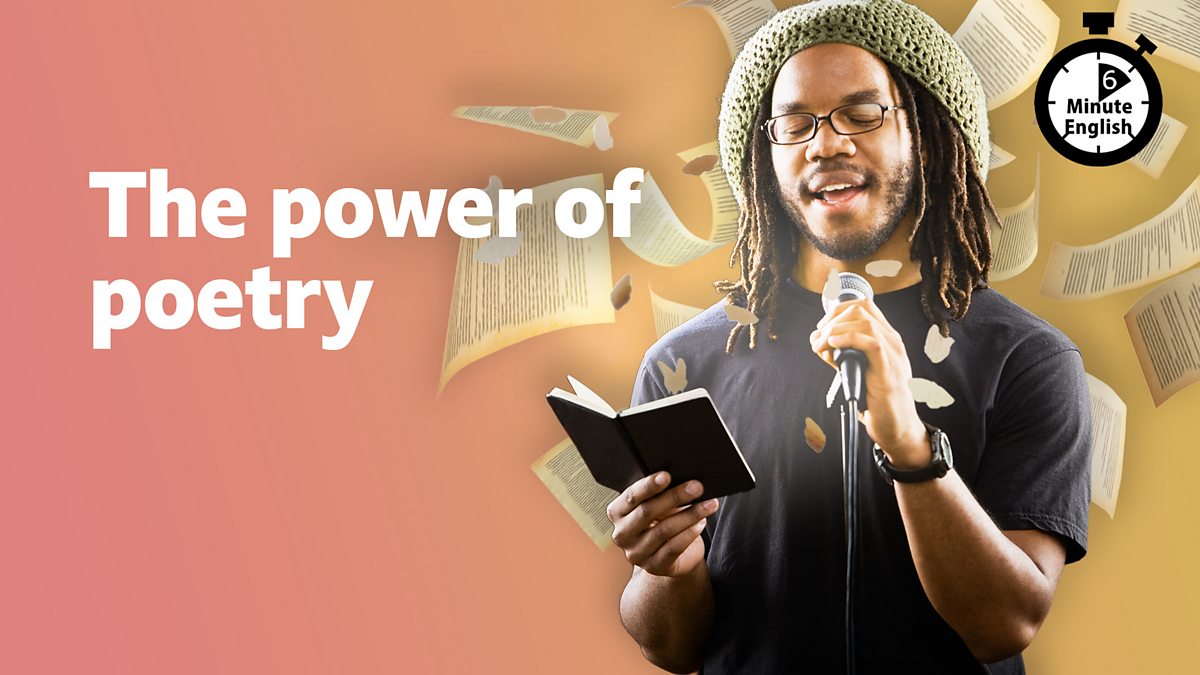
Hello, this is 6 Minute English from BBC Learning English. I'm Neil. PippaAnd I'm Pippa. In this episode we're discussing poetry. For some, poetry is what you study at school, then forget, while for others it becomes an important part of their life. Have you ever read or written any poetry, Neil? NeilWell, I haven't written any poetry since I was at school. I would love to read more poetry, but I just don't get it, really. I find it difficult to understand. PippaA good place to hear poetry is an open mic night, a live event where anyone is allowed to stand up on stage to sing or recite poems. Here, BBC reporter Maria recites her open mic poem about a friend who suffered a stroke, for BBC World Service programme People Fixing the World. MariaThis first poem, I wrote it about a friend who I love dearly. It's called Stroke. You're awakeAnd trying to grasp who it is.I pull my mask past my lips and you study my face,Eyes wide.I've enough stuff to tell you, I say,Sinking into a chair.I stare. Sometimes if you go to an open mic night, people can really touch your soul with what they're saying. And even if you're having a bad day, life can feel so much better after going to an open mic night.NeilFor Maria, poetry has the power to heal emotions and touch your soul, meaning to affect you deeply on an emotional or spiritual level. PippaIn this episode, we'll hear more about the positive power of poetry and, as usual, we'll learn some useful new words and phrases. And remember, you'll find all the vocabulary, plus a quiz and worksheet on our website, bbclearningenglish.com.
But first, I have a question for you, Pippa. Just now, you used the phrase the positive power of poetry, repeating the same initial 'p' sound across a string of words. Doing this is a common feature of poetry, but what's it called? Is it: a) assonance,b) alliteration, orc) simile? PippaHmm. Finally, my English degree might come in handy! And I'm going to say b) alliteration. NeilWell, we'll find out at the end, and I hope you don't get embarrassed, Pippa! Now, poetry helped Maria overcome sadness, but could its power to heal work in other areas too? Hot Poets is a group helping people understand the science behind global issues like climate change. They go to meetings like the UN Climate Conference and listen to scientific papers being presented. Then they write a poem about it all and perform that back to the audience. Here's Hot Poet Liv Torc, reciting her poem to BBC World Service's People Fixing the World. Liv TorcIt starts with an adventure at sea,A big blue murder mystery, where the killer is not the whaleBut an epic humanity failOf overfishing and polluting at unimaginable scale. PippaLiv's poem is based on a study into biodiversity. It's a complex research project that many find hard to understand. Here, Liv discusses this with Myra Anubi for BBC World Service programme People Fixing the World:Myra AnubiAnd Liv, I mean, so what you've identified is that there is an issue around the communication of science. Liv TorcYes, a lot of this jargon is really hard to understand, or a lot of the science is quite impenetrable to normal people, so it's instantly a turn-off. NeilScience uses lots of jargon specialist or technical vocabulary which is quite different from everyday language. For example, a scientist might use the word precipitation, while in everyday English we would say rain. PippaJargon can make scientific papers impenetrable, an adjective meaning impossible to understand. And worse, it makes science a turn-off something that people dislike or find uninteresting. NeilHot Poets try to change all of that by making complex environmental ideas easy to understand through poetry. And it works, says Kat Bruce, the environmental scientist whose study Liv based her poem on, talking here with Myra Anubi for BBC World Service's People Fixing the World. Myra AnubiWhat did it mean for you, Kat, hearing the poem, having actually experienced everything she's saying? Kat BruceIt still gives me goosebumps when I hear it now. I think it's everything that I wish I could say and put into words myself. I feel like Liv just, you know, has done that. PippaLiv's poem gave Kat goosebumps, meaning she was so emotionally affected that the hairs on her skin stood up, making tiny bumps. Maybe poetry can't fix everything, but for Kat, it's making an impact for good. Now, what was the answer to your question, Neil? NeilWell, you seemed very clear, Pippa, that when you use a string of words beginning with the same sound, it's called alliteration... and you're absolutely right.PippaPhew! NeilOK. Let's recap the vocabulary we've learned, starting with open mic night, a live event where anyone is allowed to perform poems or music on stage. PippaIf something touches your soul, it affects you deeply on an emotional or spiritual level. NeilJargon means special words and phrases that are used in a particular profession or subject. PippaThe adjective impenetrable means impossible to understand. NeilA turn-off is something that people dislike or find uninteresting. PippaAnd finally, if you get goosebumps, the hairs on your skin stand up because you're cold, emotionally affected, or afraid. Once again, our six minutes are up, but remember, you'll find lots more episodes as well as a quiz and worksheet for this one on our website, bbclearningenglish.com. See you again soon. But for now, it's goodbye. NeilGoodbye!
Find an A-Z list of our programmes.
Learn more about jargon in this Business jargon podcast series.
Practise your reading skills with The Reading Room.
How do you feel about being rejected?
What's better for learning languages – an app or a class?
Every year we see damage, death and destruction caused by hurricanes, cyclones and typhoons - tropical storms. Is climate change making this impact worse?
What is your favourite smell?
Now try this...
Practise your skills with more lessons from 6 Minute English.
Gratis selamanya · Akses penuh
Go to full course →This lesson includes:
- 🎧Audio lesson
- 📄Downloadable PDF
- 📝Full transcript
- ♾️Full access — free forever
Takeaways
Podcast
6 Minute EnglishLatest 6 Minute English
6 Minute English / Scared of speaking English?
Episode 260122 / 22 Jan 2026
Beth and Pippa talk about why we often find speaking a new language scary.
6 Minute English / Can AI solve crime?
Episode 250417 / 17 Apr 2025
Could artificial intelligence be used to solve a murder?
6 Minute English / Learning multiple languages
Episode 250410 / 10 Apr 2025
Is learning languages good for you?
6 Minute English / Are we getting more allergic to things?
Episode 250403 / 03 Apr 2025
Do you know anyone who has 50+ allergies?
6 Minute English / The country that measures happiness
Episode 250306 / 06 Mar 2025
Is happiness the key to success?
6 Minute English / Becoming a musician
Episode 250130 / 30 Jan 2025
Hear about life as a professional musician

6 Minute English / Is rejection good for us?
Episode 260917 / 17 Sep 2026
How do you feel about being rejected?

6 Minute English / Can apps teach you a language?
Episode 260910 / 10 Sep 2026
What's better for learning languages – an app or a class?

6 Minute English / Climate change and extreme weather
Episode 260903 / 03 Sep 2026
Every year we see damage, death and destruction caused by hurricanes, cyclones and typhoons - tropical storms. Is climate change making this impact worse?

6 Minute English / How do we describe smells?
Episode 260827 / 27 Aug 2026
What is your favourite smell?