6 Minute English
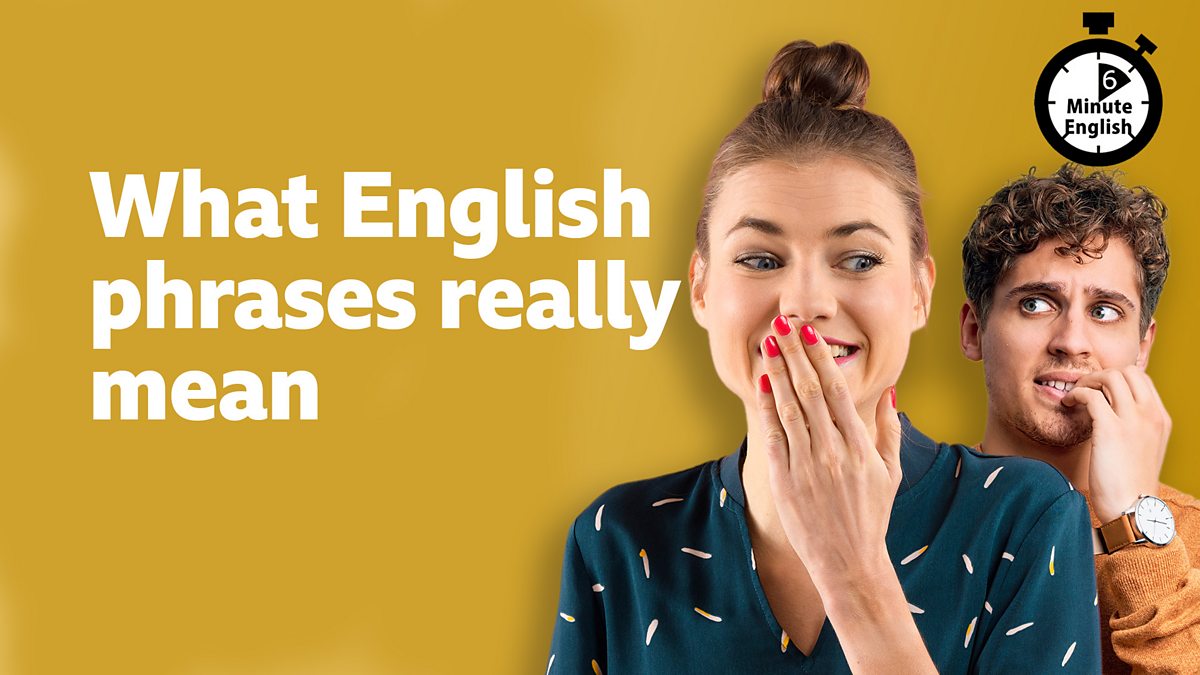
medium level6 Minute English / What English phrases really mean
Transcript
Note: This is a transcript of a spoken conversation and is not a word-for-word script.
Note: This is not a word-for-word transcript.
Hello, this is 6 Minute English from BBC Learning English. I'm Pippa. BethAnd I'm Beth. In English, what we say and what we mean are sometimes two very different things. We often use exaggeration for emphasis or for humour something known as hyperbole. For example, people say, "I am so hungry I could eat a horse," but of course no one really could. Here's presenter Michael Rosen and linguist Derek Bousfield discussing one example of hyperbole on BBC Radio 4's Word of Mouth: Michael RosenPeople do say, "Absolute nightmare!" Derek BousfieldYeah, or as my daughters would say, "I've had a mare today." And when they say mare, which is obviously shortened from 'nightmare', what it basically means is they've had a mild and potentially slightly humorous occurrence at work. PippaYou might call an unpleasant or difficult experience 'a nightmare'. Derek's daughter used the word mare, short for 'nightmare', to describe her terrible day at work. But she was exaggerating. Her day wasn't really terrible more like strange or annoying. Can you remember a time when what you said wasn't really what you meant, Beth? BethWell, sometimes we say, "Hi, y'alright?" which means: "Hi, are you alright?" like, "Are you OK?" But actually, we don't really want to hear the answer. It just means 'hello', doesn't it? PippaMmm, yeah. I have a friend who actually just says, "Alright?" and they just mean, "Hello." They don't mean, "Are you OK?" They don't want to hear about my day. BethNo. If you're having a bad day, they don't want to know. They're just saying hello. In this episode, we'll be finding out more about how the meaning of words changes in English. As usual, we'll be learning some useful new words and phrases. And remember, you'll find all the vocabulary from this episode on our website, bbclearningenglish.com. PippaBut first, I have a question for you, Beth. The word hyperbole comes from two ancient Greek words: huper andballo.But what is their literal meaning? Is it: a) to overthrow,b) to over speak, orc) to overthink? BethI have no idea, Pippa. I'm going to say to over speak. PippaOK. We'll find out the answer at the end of the programme. It's not just hyperbole that changes the meaning of words. Its opposite, something called understatement, has the same effect too. Understatement involves de-emphasising something. For example, imagine you were served an awful meal in a restaurant, but instead of saying how bad the food was, you just said, "It was less than perfect." Here's linguist Derek Bousfield discussing understatement on BBC Radio 4's Word of Mouth. Dr Derek BousfieldWe love understatement as a way of, kind of, signalling that something much more serious has gone on. And it's a kind of performative, sardonic, not-taking-oneself-too-seriously identity when you do that, because, you know, taking yourself too seriously is a no-no in British culture. Michael RosenYes. Derek BousfieldAnd so, linguistically, not taking yourself too seriously is really the done thing. BethUnderstatement is valued in British culture, unlike taking yourself too seriously. If you take yourself too seriously, you think you're more important than you really are. In Britain, this is a no-no a way of behaving that is not socially acceptable. In other words, it's not the done thing, meaning it's not what you're expected to do in a particular social situation. PippaAnother area where the meaning of words can be easily misunderstood is apologising. Here, Michael Rosen responds to an imaginary situation where his toe gets accidentally stepped on by Derek Bousfield, for BBC Radio 4 programme Word of Mouth: Derek BousfieldImagine I stepped on your toe and I said, "Oh, Michael, I'm really sorry." And you said, "It's all good." Michael RosenOh, right. That probably means it isn't. Derek BousfieldYeah! Michael RosenYes, I'm actually a bit miffed, a little bit annoyed, but then I don't want to have a barney with you. You're a stranger, so I don't want to get into a whole thing, so I say, "Yeah... it's all good." Derek Bousfield"It's all good." Exactly. It's a bit like... I mean, that's a British English one an equivalent American English one would be: "No worries." BethIf someone tells you, "It's all good," they could actually be feeling miffed an adjective meaning slightly annoyed or hurt by someone's behaviour. PippaBut no matter how annoyed you are, you probably don't want to get into a barney a loud argument or quarrel. So, you say something like, "It's all good," or, "No worries," and move on. BethAs an English learner, unclear word meanings are a challenge. A lot depends on the situation and on the relationship between speaker and listener. So, don't be shy! Get talking to others in English and if you make a mistake say, "No worries!" and carry on. OK. Pippa, I think it's time to reveal the answer to your question. PippaYes, you thought the ancient Greek words huper and ballo meant over speak, but the answer was actually a) to overthrow huper means beyond, and ballo means I throw. BethOh well! OK. Let's recap the vocabulary we've learnt, starting with mare, short for nightmare, meaning an unpleasant or difficult experience. PippaIf you take yourself too seriously,you consider yourself and your actions more important than they really are. In Britain, this is a no-no a way of behaving that is not socially acceptable. BethThe done thing, on the other hand, is what you are expected to do in a particular social situation. PippaIf you're miffed, you're slightly annoyed by someone's behaviour. BethAnd finally, a barney is a loud argument or quarrel. Once again, our six minutes are up but if you're keen to practise these new words and phrases, then check out our website, bbclearningenglish.com, where you'll find a worksheet and quiz for this episode. See you again soon. But for now, goodbye! PippaBye!
Find an A-Z list of our programmes.
To learn English from news headlines, listen to Learning English from the News.
Practise your reading skills with The Reading Room.
How do you feel about being rejected?
What's better for learning languages – an app or a class?
Every year we see damage, death and destruction caused by hurricanes, cyclones and typhoons - tropical storms. Is climate change making this impact worse?
What is your favourite smell?
Would you trust a robot to drive you around a city?
Now try this...
Practise your skills with more lessons from 6 Minute English.
Gratis selamanya · Akses penuh
Go to full course →This lesson includes:
- 🎧Audio lesson
- 📄Downloadable PDF
- 📝Full transcript
- ♾️Full access — free forever
Takeaways
Podcast
6 Minute EnglishLatest 6 Minute English
6 Minute English / Scared of speaking English?
Episode 260122 / 22 Jan 2026
Beth and Pippa talk about why we often find speaking a new language scary.
6 Minute English / Can AI solve crime?
Episode 250417 / 17 Apr 2025
Could artificial intelligence be used to solve a murder?
6 Minute English / Learning multiple languages
Episode 250410 / 10 Apr 2025
Is learning languages good for you?
6 Minute English / Are we getting more allergic to things?
Episode 250403 / 03 Apr 2025
Do you know anyone who has 50+ allergies?
6 Minute English / The country that measures happiness
Episode 250306 / 06 Mar 2025
Is happiness the key to success?
6 Minute English / Becoming a musician
Episode 250130 / 30 Jan 2025
Hear about life as a professional musician

6 Minute English / Is rejection good for us?
Episode 260917 / 17 Sep 2026
How do you feel about being rejected?

6 Minute English / Can apps teach you a language?
Episode 260910 / 10 Sep 2026
What's better for learning languages – an app or a class?

6 Minute English / Climate change and extreme weather
Episode 260903 / 03 Sep 2026
Every year we see damage, death and destruction caused by hurricanes, cyclones and typhoons - tropical storms. Is climate change making this impact worse?

6 Minute English / How do we describe smells?
Episode 260827 / 27 Aug 2026
What is your favourite smell?