6 Minute English
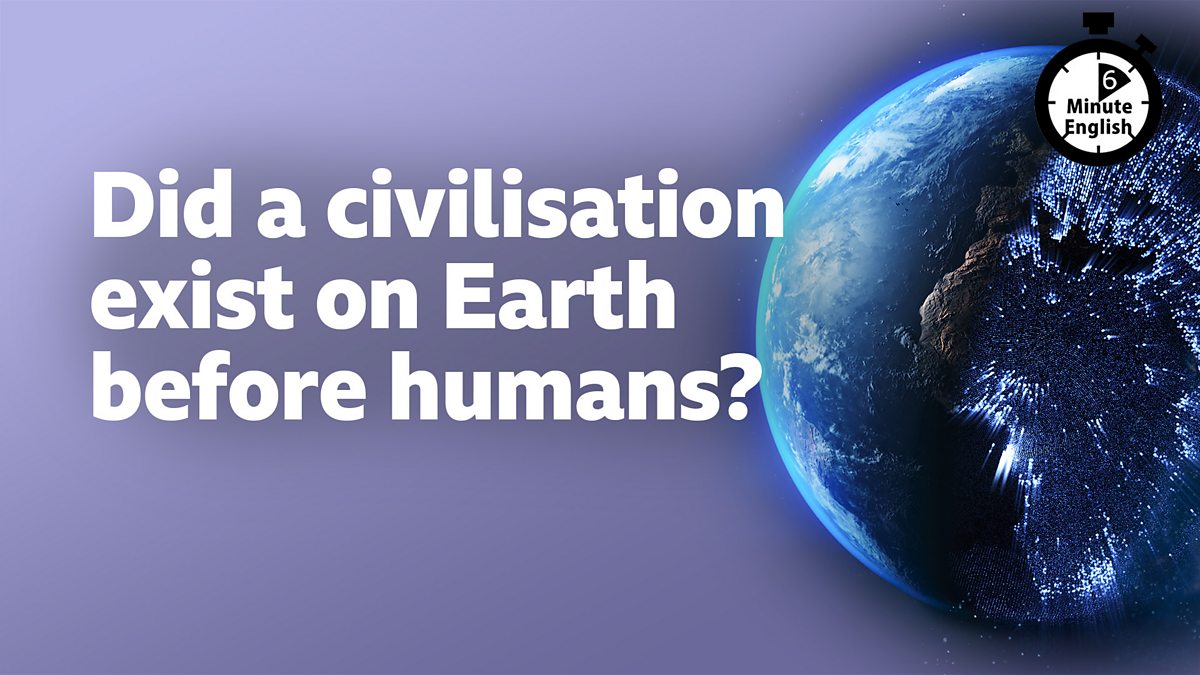
medium level6 Minute English / Did a civilisation exist on Earth before humans?
Transcript
Note: This is a transcript of a spoken conversation and is not a word-for-word script.
Note: This is not a word-for-word transcript.
Hello, this is 6 Minute English from BBC Learning English. I'm Beth. PhilAnd I'm Phil. BethPhil, do you believe there's life on other planets? PhilWell, there's a lot of other planets, so yeah, I think there must be. BethYeah, I agree. Well, it's a question that interests American astrophysicist Adam Frank, who discussed it with his colleague Gavin Schmidt, director of Nasa's Institute for Space Studies. Here, Adam recalls their conversation for BBC World Service programme CrowdScience: Adam FrankWe know that there's been no other civilisation on Earth, and he stopped me and said, "How do you know that?" And my jaw just dropped down to the floor. PhilAdam's jaw dropped an idiom for when someone looks shocked and surprised. Could there have been a technologically advanced civilisation before us, here on Earth? BethIt may sound weird but this idea has a scientific name. Here is Caroline Steel, presenter of BBC's CrowdScience, to explain:Caroline SteelThe Silurian hypothesis proposes that if there was a technologically advanced civilisation hundreds of millions of years ago, we wouldn't be able to find traces of it. PhilA hypothesis is an idea which explains how something happens and can be tested to find out if it's correct. In this episode, we'll be discussing the Silurian hypothesis: the idea that a technologically advanced civilisation existed before us on Earth but vanished without leaving a trace. As usual, we'll be learning some useful new words and idioms, and remember you'll find all the vocabulary on our website, bbclearningenglish.com. BethBut first, I have a question for you, Phil. Human civilisation is thousands of years old but the planet itself is much older. So, how old do scientists think the Earth is? Is it: a) 3.5 billion years,b) 4.5 billion years, orc) 5.5 billion years? PhilI'm going to guess c) 5.5 billion years. BethOK. Well, we will find the answer out later in the programme. To believe a technologically advanced civilisation existed on Earth hundreds of millions of years ago, most people would probably want evidence. We have evidence about other species from the past, such as the dinosaurs, from fossils the remains of prehistoric plants or animals that have been preserved in rock for a very long time. PhilBut according to Adam Frank, fossils won't help prove the Silurian hypothesis, as he explains here to BBC World Service programme, CrowdScience: Adam FrankMost things are not fossilised. It's only a tiny fraction of Earth's life that has ever become fossilised. So, imagine that you have a 10,000-year-long civilisation, which is a blink of the eye for geology that's too short to really create a lot of fossils. BethAdam argues that only a tiny fraction meaning a very small amount of life on Earth has turned into fossil. PhilIn geological time, even a 10,000-year-old civilisation is the blink of an eye an idiom meaning a very short period of time. In other words, older civilisations might have existed on Earth but not for long enough to leave fossilised evidence. BethHowever, not everyone is convinced by Adam's ideas. Evidence of our own civilisation, including plastics and man-made materials like concrete, is already being layered into the Earth's crust, and these are going to last a very long time. So, surely a technologically advanced civilisation from prehistory would have left similar marks. PhilWell, here's Adam Frank again, answering these objections on BBC World Service programme, CrowdScience: Adam FrankWhat happens is somebody else will pick up on their work, either affirming it and showing new evidence for it or pushing back on it, and once you get to, like, 20, 30 or 40 papers, then you have a consensus.You're like, "OK. We've really, really looked at this and now we know." BethAdam welcomes new evidence, even evidence which contradicts his ideas, as part of the scientific method needed to prove a hypothesis right or wrong. It's how scientists form a consensus meaning a general agreement about the issue. PhilPersonally, I think the idea of prehistoric civilisations on Earth is so mysterious, it's OK to keep an open mind. Now, isn't it time you revealed the answer to your question, Beth? BethI think it is. I asked you, "How old do scientists think the Earth is?" You said, "5.5 billion years," and I'm afraid you were wrong, Phil. It's 4.5 billion years. OK. Let's recap the vocabulary we've learnt, starting with the idiom my jaw dropped, which is used to say someone looks very shocked and surprised.PhilA hypothesis is a suggestion that's proposed to explain something, which can then be tested to see if it's true. BethFossils are the remains of prehistoric plants or animals that have been preserved in rock for a very long time. PhilA tiny fraction of something is a very small amount of it. BethThe idiom the blink of an eye means a very short period of time. PhilAnd finally, a consensus is a general agreement. Once again, our six minutes are up, but if you're keen for more, then head over to our website, bbclearningenglish.com, where you'll find a worksheet and a quiz for this episode. See you again soon. But for now, it's goodbye! BethGoodbye!
Learn more about science and technology in English here.
Find an A-Z list of our programmes.
Want to practise your reading skills? Try The Reading Room.
Beth and Neil talk about a strange emotion we can feel at Christmas called nostalgia
Would you know how to spot a Death Cap mushroom?
Could your next therapist be a horse?
Have you ever tried a crisp sandwich?
Do you follow politics on social media?
Now try this...
Practise your skills with more lessons from 6 Minute English.
Gratis selamanya · Akses penuh
Go to full course →This lesson includes:
- 🎧Audio lesson
- 📄Downloadable PDF
- 📝Full transcript
- ♾️Full access — free forever
Takeaways
Podcast
6 Minute EnglishLatest 6 Minute English

6 Minute English / Scared of speaking English?
Episode 260122 / 22 Jan 2026
Beth and Pippa talk about why we often find speaking a new language scary.
6 Minute English / Can AI solve crime?
Episode 250417 / 17 Apr 2025
Could artificial intelligence be used to solve a murder?

6 Minute English / Learning multiple languages
Episode 250410 / 10 Apr 2025
Is learning languages good for you?

6 Minute English / Are we getting more allergic to things?
Episode 250403 / 03 Apr 2025
Do you know anyone who has 50+ allergies?

6 Minute English / The country that measures happiness
Episode 250306 / 06 Mar 2025
Is happiness the key to success?

6 Minute English / Becoming a musician
Episode 250130 / 30 Jan 2025
Hear about life as a professional musician

6 Minute English / Is rejection good for us?
Episode 260917 / 17 Sep 2026
How do you feel about being rejected?

6 Minute English / Can apps teach you a language?
Episode 260910 / 10 Sep 2026
What's better for learning languages – an app or a class?

6 Minute English / Climate change and extreme weather
Episode 260903 / 03 Sep 2026
Every year we see damage, death and destruction caused by hurricanes, cyclones and typhoons - tropical storms. Is climate change making this impact worse?

6 Minute English / How do we describe smells?
Episode 260827 / 27 Aug 2026
What is your favourite smell?