6 Minute English
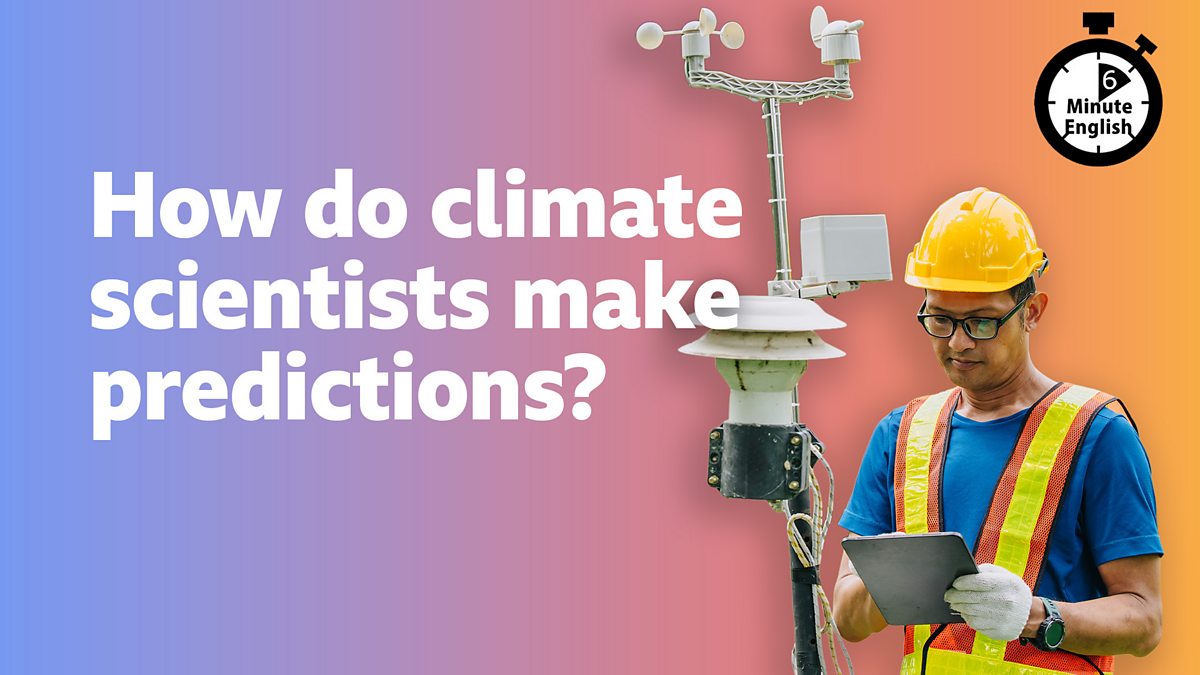
medium level6 Minute English / How do climate scientists make predictions?
Transcript
Note: This is a transcript of a spoken conversation and is not a word-for-word script.
Note: This is not a word-for-word transcript.
Hello, this is 6 Minute English from BBC Learning English. I'm Phil. PippaAnd I'm Pippa. PhilThis summer is becoming one of the hottest ever with heatwaves across Europe. Here in the UK, a new record for the highest June temperature was set at a sweltering 37.7 C. It seems that year after year, temperatures are going up. In 2015, the COP21 summit agreed to limit global warming to 1.5 C, but since then research shows temperatures exceeding that, leading to warnings of catastrophic damage to Earth's life support systems. In this episode, we'll be discussing how hot the planet could get, using some useful new vocabulary. And remember, you'll find a free transcript to read along with on our website, bbclearningenglish.com.
But first, I have a question for you, Phil. Scientists monitor climate change using the Earth's energy imbalance the difference between the solar energy entering the Earth's atmosphere and the radiation going back out into space. But which unit do scientists use for this? Is it: a) Fahrenheit,b) Watts per square metre, orc) Joules? PhilOoh, I know Joules is something to do with energy, so I'm going to go with c). PippaWell, we'll find out the answer at the end of the programme, although careful listeners might hear the answer sooner. PhilOoh! PippaYes, exciting! So, how do scientists calculate the effects of climate change in the first place? The answer is with models. Huge amounts of physical and chemical data are fed into supercomputers, which then paint pictures of possible futures on Earth. But, as NASA climate scientist Kate Marvel explained to BBC World Service programme The Climate Question, nothing is certain. Kate MarvelClimate models don't make predictions they make projections. Predictions are saying this is what will happen and a projection is conditional. A projection is: "If we do this, then this will happen." PhilClimate models don't make predictions. Those are statements about what's likely to happen. Instead, they make projections about different possible futures, and these depend on many things. In other words, climate models are conditional, meaning that they depend on other factors. The main factor in climate change, of course, is human activity, especially greenhouse gas emissions. PippaAnother influence on climate models is clouds. We usually associate hot summers with cloudless blue skies, but in fact clouds play a big part in the climate, as Kate Marvel explained to the BBC World Service. Kate MarvelSo, the thing about clouds is that they have this dual effect. They both cool the planet by blocking sunlight, and they warm the planet because they have their own greenhouse effect. Right now, the unit that scientists use to measure the energy imbalance of the planet how much it's out of whack is Watts, like in a light bulb, per square metre. PhilKate starts by saying, "The thing about clouds is." She uses the expression the thing about to introduce the most important detail about something. Here, that detail is that clouds both cool the planet by blocking sunlight but also warm it by trapping heat. PippaSo, climate models monitor clouds to accurately measure how much the Earth is out of whack. If something is out of whack, it's out of balance and not working properly. PhilHmm. Climate models sound very complicated to me, Pippa. For one thing, how can you monitor clouds which are constantly moving and changing? PippaYeah. And how much information from around the world would the supercomputers need to make accurate projections? It's a concern that BBC presenter Graihagh Jackson raised with Kate Marvel for BBC World Service programme The Climate Question. Graihagh JacksonSurely we need to know the trajectory we're heading in, in order to adapt. Kate MarvelOh absolutely. You know, I am very pro-science. I am very pro-doing science because no climate change is unfortunately not on the table. PhilKate is very pro-science. If you're pro-something, it means you're in favour of it. Models are complex, but they're necessary because unfortunately no climate change at all is not on the table, and that's an idiom, meaning it's not an option. PippaIf all this sounds a bit depressing. Kate's final message is more hopeful. Climate models prove beyond doubt that the problem of global warming is created by humans, so we know beyond doubt that the solution is also in our hands. PhilNow, Pippa, careful listeners might already know but go ahead and reveal the correct answer to your question. PippaYes. I asked you, "Which unit do scientists use to measure the Earth's energy imbalance?" And the answer was Watts per square metre. And I didn't know that, Phil. Right, it's time to recap the vocabulary we heard during this programme. A prediction is a statement about what you think will happen in the future. PhilThe adjective conditional means depending on other factors. PippaYou can use the informal expression the thing about to introduce the most important feature or detail of something. PhilThe phrase out of whack means out of balance and not working properly. PippaIf you're pro-something, you're in favour of it. PhilAnd if something is not on the table, it's not an option. It's not available to us. PippaThat's the end of this episode of 6 Minute English. Find a worksheet and quiz on our website to test what you've learned. PhilWe'll be back next week with another episode, so make sure you don't miss it. PippaBye for now. PhilBye!
Find an A-Z list of our programmes.
Find more programmes for your level here.
Practise your reading skills with The Reading Room.
How do you feel about being rejected?
What's better for learning languages – an app or a class?
Every year we see damage, death and destruction caused by hurricanes, cyclones and typhoons - tropical storms. Is climate change making this impact worse?
What is your favourite smell?
Now try this...
Practise your skills with more lessons from 6 Minute English.
Gratis selamanya · Akses penuh
Go to full course →This lesson includes:
- 🎧Audio lesson
- 📄Downloadable PDF
- 📝Full transcript
- ♾️Full access — free forever
Takeaways
Podcast
6 Minute EnglishLatest 6 Minute English

6 Minute English / Scared of speaking English?
Episode 260122 / 22 Jan 2026
Beth and Pippa talk about why we often find speaking a new language scary.
6 Minute English / Can AI solve crime?
Episode 250417 / 17 Apr 2025
Could artificial intelligence be used to solve a murder?

6 Minute English / Learning multiple languages
Episode 250410 / 10 Apr 2025
Is learning languages good for you?

6 Minute English / Are we getting more allergic to things?
Episode 250403 / 03 Apr 2025
Do you know anyone who has 50+ allergies?

6 Minute English / The country that measures happiness
Episode 250306 / 06 Mar 2025
Is happiness the key to success?

6 Minute English / Becoming a musician
Episode 250130 / 30 Jan 2025
Hear about life as a professional musician

6 Minute English / Is rejection good for us?
Episode 260917 / 17 Sep 2026
How do you feel about being rejected?

6 Minute English / Can apps teach you a language?
Episode 260910 / 10 Sep 2026
What's better for learning languages – an app or a class?

6 Minute English / Climate change and extreme weather
Episode 260903 / 03 Sep 2026
Every year we see damage, death and destruction caused by hurricanes, cyclones and typhoons - tropical storms. Is climate change making this impact worse?

6 Minute English / How do we describe smells?
Episode 260827 / 27 Aug 2026
What is your favourite smell?