6 Minute English
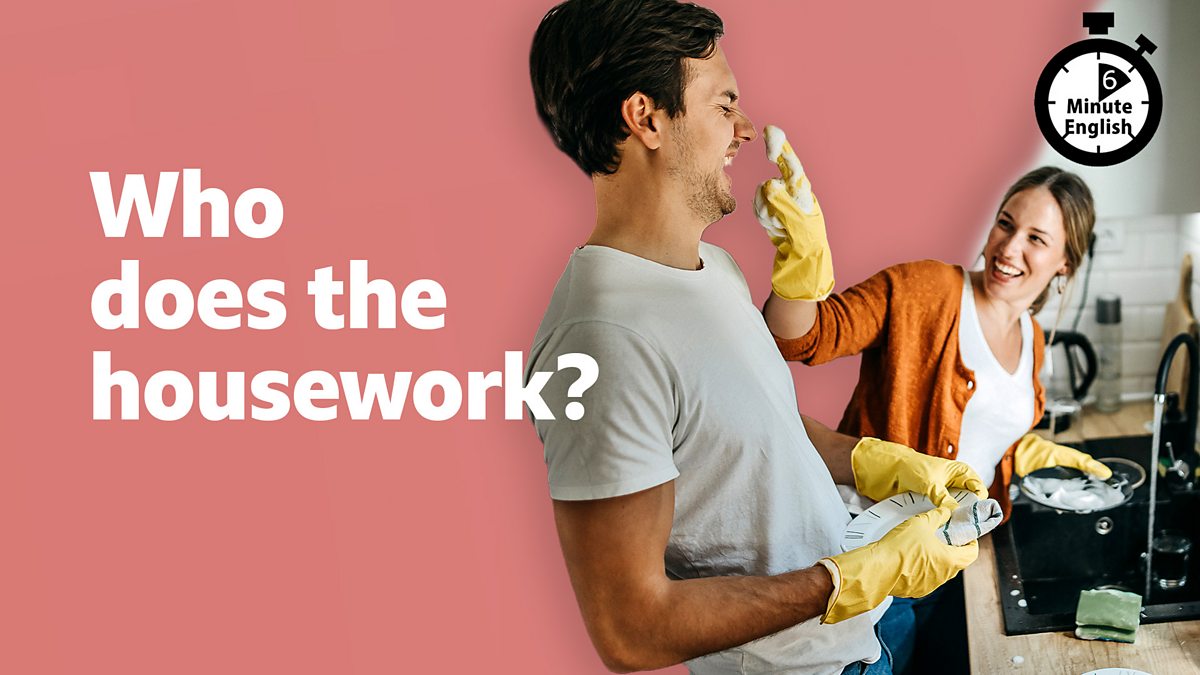
medium level6 Minute English / Who does the housework?
Transcript
Note: This is a transcript of a spoken conversation and is not a word-for-word script.
Note: This is not a word-for-word transcript.
Hello, this is 6 Minute English from BBC Learning English. I'm Neil. PippaAnd I'm Pippa. When it comes to household chores, jobs like cleaning, washing clothes or looking after the kids, it's often women who do most of the work. Here, two female listeners of BBC World Service programme People Fixing the World share their experiences. Do they sound familiar to you? Listener 1I do everything. I do all the house chores, I do the food shopping, I do all the cooking, I clean the bathroom. Listener 2Are the chores done equally between me and my husband? No, they're not done equally. I do most of the chores. PippaSo, you're a family man, Neil. Do you do your fair share of household chores? NeilI think so. My wife works part time and I work full time, so when I'm not working, I do things, and when she's not working, she does things. PippaYeah, it's similar in my house, so me and my husband try to split things, but it's difficult, isn't it? NeilIt is.PippaOf course, no one enjoys cleaning the toilet or taking out the bins, but there is a serious side to the issue. Figures from UN Women, an organisation promoting gender equality, suggest that every day women around the world spend three hours more than men on unpaid care and domestic work. So, in this episode, we'll be hearing about two projects helping husbands and wives share the housework more fairly. NeilAnd as usual, you'll find a quiz and a worksheet to go with this episode on our website, bbclearningenglish.com.
But now I have a question for you, Pippa. According to a survey conducted by Good Housekeeping magazine earlier this year, what is the most hated household chore in Britain? Is it: a) deep cleaning the oven,b) scrubbing the toilet, orc) cleaning the windows? PippaHmm. I'm going to say deep cleaning the oven because I really hate that job. I hardly ever do it. NeilI don't like any of those, but we'll find out the answer at the end of the programme. Now, the first project we're going to look at is on the remote Indonesian island of Rote. Here, men traditionally work as rice farmers or fishermen, while women look after the home, the children and older people. But with few washing machines and no running water, these domestic chores take a long time. PippaThe NGO ARUNGI runs a project trying to change attitudes about the role of the island's women. They work alongside community leaders like Mama Shilpa, who spoke with BBC World Service reporter Ade Mardiyati. Mama ShilpaIt is expected that the tasks done in the house, like holding the child, feeding the child, washing dishes, cooking, will all be done by the mother. Ade MardiyatiShilpa tells me these are all considered women's work. And you might be thinking, "Well, the man is busy in the fields, so it's just a fair division of labour." But Shilpa tells me women also help out in the fields. NeilOn Rote, cleaning, cooking and sweeping are considered women's work a negative term for boring and repetitive tasks which are traditionally done by women. PippaMany cultures have a division of labour a way of organising work where different tasks are done by different groups of people. But on Rote this means women work even harder, helping out with the farming and fishing too. NeilYou might think this only happens in traditional societies, but research suggests that women in wealthy countries also spend much more time on unpaid care work than men. One such country is Croatia, where the NGO Status M run their Superdads project. Project worker Anamarija Sočo leads workshops encouraging dads and sons to take some of the pressure off mums. Here, she explains the benefits of this to the BBC World Service. Anamarija SočoMothers have, you know, of course, more space for their careers, or hobbies, or just simply to rest I mean, just to take a breather. Women tend to especially appreciate men who do these kinds of chores. And when they start pulling their weight, then they jokingly say that, "Uh yeah, women tend to nag less." PippaSometimes mums need to take a breather an informal way of saying stop and rest a while. NeilAnamarija also thinks women appreciate it when their husbands pull their weight. If you pull your weight, you work as hard as everyone else. PippaBoth these NGO projects agree about one thing men doing more to help around the house results in happier homes, even if that means cleaning the toilet now and then. And speaking of cleaning the toilet, what was the answer to your quiz question, Neil? NeilI asked you what chore is the most hated in Britain. PippaI thought it was cleaning the oven. NeilWell, I'm afraid that's not the right answer. People hate cleaning the windows even more than scrubbing the oven. Apparently, 23% of the people who did the survey said cleaning the windows. OK. Let's recap the vocabulary we've learned, starting with chores household tasks like cleaning, washing and ironing that have to be done regularly. PippaIf you do your fair share of work, you do a reasonable amount. NeilWomen's work is a negative term for the boring and repetitive tasks which are stereotypically done by women. PippaThe division of labour is a way of organising work where different tasks are done by different groups of people. NeilThe idiom take a breather means to stop what you're doing for a short time and rest. PippaAnd finally, if you pull your weight, you work as hard as everyone else doing the same job. Once again, our six minutes are up, but remember, you can find a free transcript including all the vocabulary on our website, at bbclearningenglish.com. Goodbye for now. NeilGoodbye!
Find an A-Z list of our programmes.
Find more programmes for your level here.
Practise your reading skills with The Reading Room.
How do you feel about being rejected?
What's better for learning languages – an app or a class?
Every year we see damage, death and destruction caused by hurricanes, cyclones and typhoons - tropical storms. Is climate change making this impact worse?
What is your favourite smell?
Now try this...
Practise your skills with more lessons from 6 Minute English.
Gratis selamanya · Akses penuh
Go to full course →This lesson includes:
- 🎧Audio lesson
- 📄Downloadable PDF
- 📝Full transcript
- ♾️Full access — free forever
Takeaways
Podcast
6 Minute EnglishLatest 6 Minute English
6 Minute English / Scared of speaking English?
Episode 260122 / 22 Jan 2026
Beth and Pippa talk about why we often find speaking a new language scary.

6 Minute English / Can AI solve crime?
Episode 250417 / 17 Apr 2025
Could artificial intelligence be used to solve a murder?

6 Minute English / Learning multiple languages
Episode 250410 / 10 Apr 2025
Is learning languages good for you?
6 Minute English / Are we getting more allergic to things?
Episode 250403 / 03 Apr 2025
Do you know anyone who has 50+ allergies?
6 Minute English / The country that measures happiness
Episode 250306 / 06 Mar 2025
Is happiness the key to success?
6 Minute English / Becoming a musician
Episode 250130 / 30 Jan 2025
Hear about life as a professional musician

6 Minute English / Is rejection good for us?
Episode 260917 / 17 Sep 2026
How do you feel about being rejected?

6 Minute English / Can apps teach you a language?
Episode 260910 / 10 Sep 2026
What's better for learning languages – an app or a class?

6 Minute English / Climate change and extreme weather
Episode 260903 / 03 Sep 2026
Every year we see damage, death and destruction caused by hurricanes, cyclones and typhoons - tropical storms. Is climate change making this impact worse?

6 Minute English / How do we describe smells?
Episode 260827 / 27 Aug 2026
What is your favourite smell?