6 Minute English
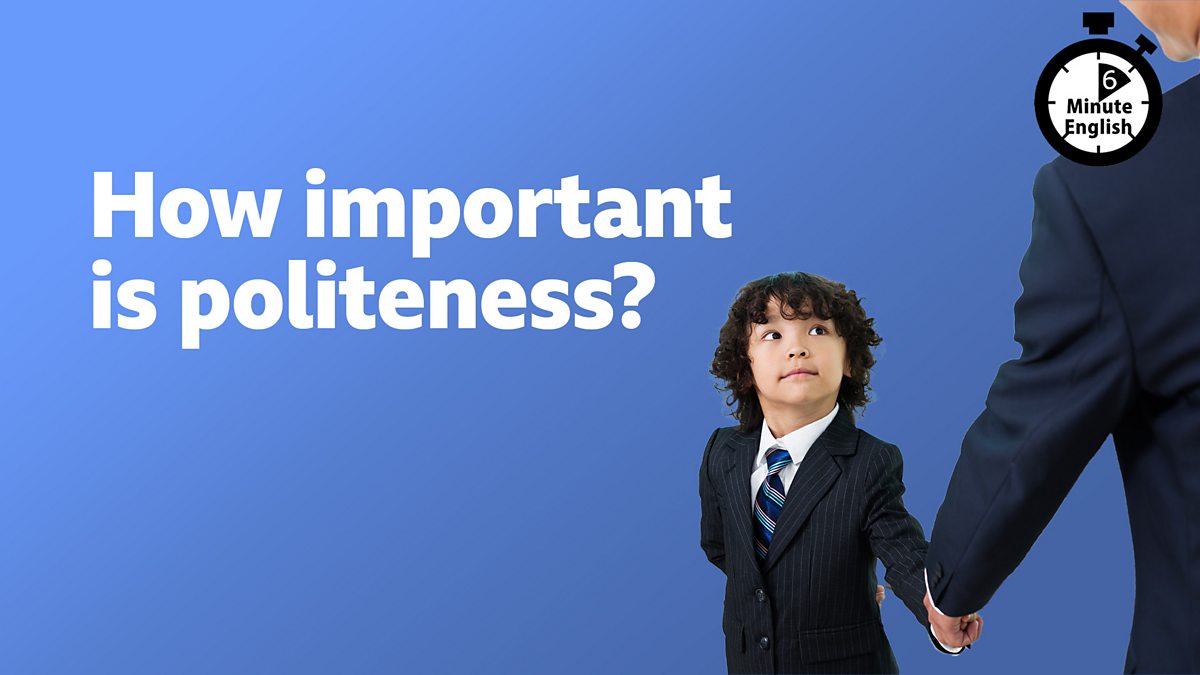
medium level6 Minute English / How important is politeness?
Transcript
Note: This is a transcript of a spoken conversation and is not a word-for-word script.
Note: This is not a word-for-word transcript.
Hello, this is 6 Minute English from BBC Learning English. I'm Neil. BethAnd I'm Beth. In this programme, we're talking about politeness. Britain has a reputation for being a polite place where children are told to say 'please' and 'thank you', but in real life that isn't always true. You, give me that pen!NeilI'm sorry. That was a bit rude. BethWell, what should I have said? NeilHow about: "Neil, please could you pass me the pen?" BethFine. Neil, could you please pass me the pen? NeilThere you go! That's much better. BethNow listen as BBC Radio 4 presenter Michael Rosen, who is a well-known poet and children's author in Britain, describes what happened to him one day: Michael RosenRecently, this is how it went: a boy was walking past me in the street, stopped and said, "Hey! You're thingy, innit!" Now, that one seems to break all the rules. And because it broke the rules, it gave me a problem. How do I answer it? BethA boy saw Michael Rosen and said, "Hey! You're thingy, innit!" He used the word thingy because, although he recognised Michael, he couldn't remember his name. He also said innit, which is short for 'isn't it', to emphasise what he'd said. NeilSo, was the boy being impolite or was he just happy meeting a famous person in the street? And why do we teach kids to be polite in the first place? That's what we'll be discussing in this programme, using some useful new vocabulary. BethBut first, I have a question for you, Neil. The British are well known for being polite, as we've said, and there's even an idiom we use in certain situations to remind someone to be especially polite. But what is it? Is it: a) mind your As and Bs,b) mind your Ps and Qs, orc) mind your Xs and Ys? NeilWell, I know the answer to this, but I'm going to say c) mind your Xs and Ys, because I think it's brilliant. BethOK. Interesting! Well, we'll find out the correct answer later in the programme. So, let's return to the boy who said, "Hey! You're thingy, innit!" to famous poet, Michael Rosen. Was that impolite or not? Professor Louise Mullany, who studies the language of politeness, has an answer. She thinks that politeness is as much to do with the person being spoken to as the person speaking, as she explained to BBC Radio 4 programme, Word of Mouth: Louise MullanyI think the crucial thing there is in how you've perceived it. So, obviously he's not giving us the conventional: "Oh, good afternoon, Mr Rosen," or a more formal approach. It's very, very informal and he can't remember your name, and he's saying 'innit'. Now, that has been interpreted by you as non-threatening to you. You don't see him as insulting you, and you're actually quite kindly disposed to that person. So, you haven't interpreted it as offensive or aggressive. You said I think you described it as being quite civil, actually. NeilMichael Rosen didn't feel that the boy was insulting him. To insult someone means to be rude or offensive to them. BethAlthough his speech was very informal, Michael thought the boy was actually pleased to see him, not rude at all. Micheal was well disposed to the boy he liked and approved of him. NeilSo, you could say that politeness is subjective; if Michael doesn't feel offended, then where is the offence? Then why do we teach children to be polite at all? Well, according to Professor Mullany, it's to do with the rules of society. BethThat's right. Louise thinks that by teaching our kids politeness they enjoy the benefits of being accepted in society. So, imagine how embarrassed she felt when her two-year-old daughter repeatedly ignored the cook at her nursery school and refused to say hello. Here's Louise Mullany telling the story to BBC Radio 4's Word of Mouth: Louise MullanyThe cook looked so disappointed. And as I mention in the book, it felt to me like there were lots of other children skipping skipping and jumping past going, "Hello!" being really friendly children, and my daughter was just there. And we started to make excuses for her, like, "Oh, she's tired. Oh, she's teething. She's this and she's that," because the embarrassment was so strong. And I felt awful walking back past the kitchen on my way out. I was almost trying to hide my face, going, "I'm the one with the really rude child." NeilWhen her daughter didn't say hello to an adult, Louise made excuses for her. If you make excuses for someone, you try to explain the reasons for their behaviour. For example, Louise said her daughter was tired, she was growing new teeth, she was this and that. The idiom this and that can be used to describe various unspecified things. For example, if someone asks what you did this afternoon, you might reply, "Oh, not much. I stayed at home, I watched TV, I did this and that." BethPoliteness means different things to different people, but we still like it when people are polite to us, and I think the polite thing to do now is reveal the answer to my question, Neil. So, the idiom that we use to remind someone to be polite is not 'mind your Xs and Ys' I'm sorry, Neil. It's 'mind your Ps and Qs'. NeilThat's a shame. Xs and Ys is much better. BethOK. Now, let's recap the vocabulary we've learnt, starting with thingy, an informal word that's used if you can't remember someone's or something's name. People also use the slang words, what's-his-name or what's-her-name, for the same reason. NeilInnit is a short form of the tag question, 'isn't it'. It's used to add emphasis to a statement. BethThe adjective insulting means rude or offensive NeilIf you are well disposed to someone, you like and approve of them. BethWhen you make excuses for someone, you explain the reasons for their bad behaviour. NeilAnd finally, the idiom this and that describes various unspecified things. Once again, our six minutes are up, but why not test yourself with the programme quiz and worksheet, available now on our website bbclearningenglish.com. Goodbye for now. BethBye!
Beth and Neil talk about a strange emotion we can feel at Christmas called nostalgia
Would you know how to spot a Death Cap mushroom?
Could your next therapist be a horse?
Have you ever tried a crisp sandwich?
Do you follow politics on social media?
What's the worst thing someone can do while eating?
Would you ever consider playing in a bomb site?
Have you ever had garlic breath?
Now try this...
Practise your skills with more lessons from 6 Minute English.
Gratis selamanya · Akses penuh
Go to full course →This lesson includes:
- 🎧Audio lesson
- 📄Downloadable PDF
- 📝Full transcript
- ♾️Full access — free forever
Takeaways
Podcast
6 Minute EnglishLatest 6 Minute English
6 Minute English / Scared of speaking English?
Episode 260122 / 22 Jan 2026
Beth and Pippa talk about why we often find speaking a new language scary.
6 Minute English / Can AI solve crime?
Episode 250417 / 17 Apr 2025
Could artificial intelligence be used to solve a murder?
6 Minute English / Learning multiple languages
Episode 250410 / 10 Apr 2025
Is learning languages good for you?
6 Minute English / Are we getting more allergic to things?
Episode 250403 / 03 Apr 2025
Do you know anyone who has 50+ allergies?
6 Minute English / The country that measures happiness
Episode 250306 / 06 Mar 2025
Is happiness the key to success?
6 Minute English / Becoming a musician
Episode 250130 / 30 Jan 2025
Hear about life as a professional musician

6 Minute English / Is rejection good for us?
Episode 260917 / 17 Sep 2026
How do you feel about being rejected?

6 Minute English / Can apps teach you a language?
Episode 260910 / 10 Sep 2026
What's better for learning languages – an app or a class?

6 Minute English / Climate change and extreme weather
Episode 260903 / 03 Sep 2026
Every year we see damage, death and destruction caused by hurricanes, cyclones and typhoons - tropical storms. Is climate change making this impact worse?

6 Minute English / How do we describe smells?
Episode 260827 / 27 Aug 2026
What is your favourite smell?