6 Minute English
medium level6 Minute English / What's your favourite kind of noodle?
Transcript
Note: This is a transcript of a spoken conversation and is not a word-for-word script.
Note: This is not a word-for-word transcript.
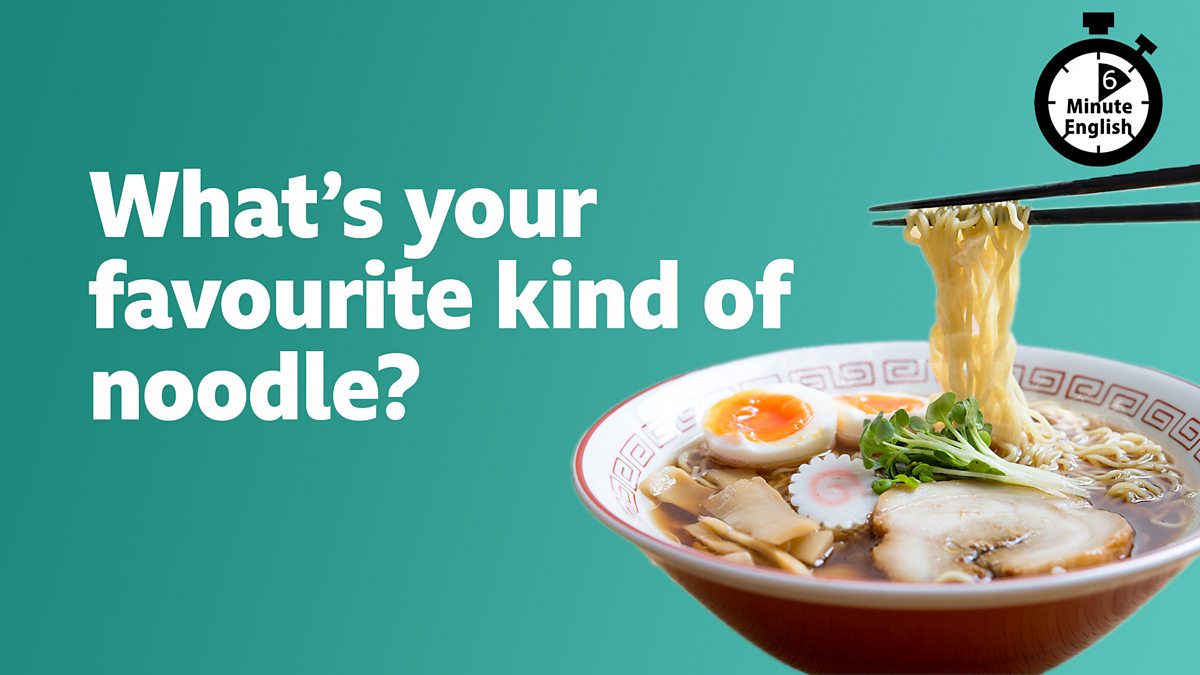
Hello, this is 6 Minute English from BBC Learning English. I'm Neil. BethAnd I'm Beth. NeilDo you enjoy eating noodles, Beth? BethI love noodles, yes. I think my favourite are udon the big thick ones. Mmm, they're so good! Well, some people buy them dried in a packet, others make them fresh from wheat or rice, but there is little doubt that noodles are popular around the world. From their origins, probably somewhere in China, noodle recipes were spread by traders on the ancient Silk Road. At each destination along the road, people gave noodles a twist, adding different flavours and ingredients to create a new dish. NeilIn this programme, we'll visit the United States and Japan, two countries which have taken noodles and created exciting new varieties. As usual, we'll learn some useful new vocabulary, and remember you can read along with the transcript of this programme, available now on our website, bbclearningenglish.com. BethBut first, Neil, I have a question for you. As well as different shapes and ingredients, noodles come in many different flavours. So which region of China is famous for its spicy flavours? Is it: a) Shanghai,b) Sichuan, orc) Guangzhou? NeilWell, I think actually, Beth, I know the answer to this. I've been lucky enough to have been to this place. I think it's b) Sichuan. BethOK. Well, you sound confident. I will reveal the answer later in the programme. BBC World Service programme, The Food Chain, investigated how noodles spread from Asia through Europe to America. They uncovered a surprising story: that pasta comes from noodles brought back to Italy by Marco Polo in the 13th century. Jen Lin-Liu, author of the book 'On the Noodle Road', doesn't believe this story. Jen Lin-LiuSo, noodles were very exotic in the 1920s and 30s in the United States, and there was a new pasta association in America that wanted to promote the manufacturing of dried pasta. And so they came up with a story about how Marco Polo went to China and found the noodle there, and brought it all the way to Italy. NeilIn the 1920s, noodles were popular because they were exotic, meaning foreign, unusual and exciting. At that time pasta companies were promoting a new invention, dried pasta, so they came up with a story about Marco Polo to sell more pasta. If you come up with something, you suggest or think up an idea. And it worked sales of pasta jumped as a result! BethNow, our second destination, Japan, also has a history of eating noodles. One of the most famous Japanese noodle dishes is ramen, and Frank Striegl, a blogger living in Tokyo, knows all about it. He eats over 300 bowls of ramen a year! He explained to BBC World Service's The Food Chain how Chinese immigrants to Japan in the late 1800s influenced this Japanese dish. Frank StrieglAnd at one point or another, different chefs decided to localise these dishes. They said, "We love these Chinese noodle dishes. However, why don't we tweak them? Why don't we make them a little bit more Japanese?" NeilFrank says that at one point or another, chefs started to make noodle dishes more Japanese. Here, the phrase at one point or another means at some unspecified time in the past. BethThey did this by tweaking Chinese noodles in other words, by changing them slightly to make them better, different or, in this case, more Japanese. NeilBy making these tweaks, adding new toppings and slices of beef or chicken, Japanese chefs created the noodle dish we know today as ramen. Here's Frank Striegl again, talking with BBC World Service's The Food Chain. Frank StrieglAnd what I find fascinating about ramen, compared to perhaps other wonderful noodle dishes around the world, is that ramen continues to evolve. Unlike other Japanese foods, it's OK to push the boundaries. BethFrank thinks that Japanese ramen continues to evolve to develop and change gradually in response to new developments and ideas. Unlike other traditional food such as sushi, modern versions of ramen push the boundaries. If you push the boundaries, you act in a way which challenges normal acceptable behaviour. NeilYes, noodles have changed so much since ancient times that today you can buy them dried in a packet and simply add hot water. But the flavours and the noodles themselves maintain a link to the past. Now, speaking of flavours, what was the answer to your question, Beth? BethWell, I asked you which region of China is famous for its spicy flavours. You were very confident with saying Sichuan and that is the correct answer. Sichuan is a place that is famous for spicy food, such as the Sichuan pepper and Sichuan hotpot. OK. It's time to recap the vocabulary we've learnt. If you give something a twist, you change it in some small way to create something new and exciting. NeilThe adjective exotic means unusual and exciting because of coming from far away. BethThe phrase, at one point or another means at some unspecified time in the past. NeilIf you tweak something, you alter it slightly in order to improve it. BethSomething which evolves, develops and changes gradually. NeilAnd finally, the idiom to push the boundaries means to do things which challenge normal acceptable behaviour. Once again, our six minutes are up. If you enjoyed the programme, why not visit our website and check out all of the different podcasts that we have at BBC Learning English. There's something there for everyone. Thanks for joining us and goodbye. BethBye!
Discover our other podcasts.
Beth and Neil talk about a strange emotion we can feel at Christmas called nostalgia
Would you know how to spot a Death Cap mushroom?
Could your next therapist be a horse?
Have you ever tried a crisp sandwich?
Do you follow politics on social media?
What's the worst thing someone can do while eating?
Would you ever consider playing in a bomb site?
Now try this...
Practise your skills with more lessons from 6 Minute English.
Gratis selamanya · Akses penuh
Go to full course →This lesson includes:
- 🎧Audio lesson
- 📝Full transcript
- ♾️Full access — free forever
Takeaways
Podcast
6 Minute EnglishLatest 6 Minute English

6 Minute English / Scared of speaking English?
Episode 260122 / 22 Jan 2026
Beth and Pippa talk about why we often find speaking a new language scary.

6 Minute English / Can AI solve crime?
Episode 250417 / 17 Apr 2025
Could artificial intelligence be used to solve a murder?

6 Minute English / Learning multiple languages
Episode 250410 / 10 Apr 2025
Is learning languages good for you?

6 Minute English / Are we getting more allergic to things?
Episode 250403 / 03 Apr 2025
Do you know anyone who has 50+ allergies?

6 Minute English / The country that measures happiness
Episode 250306 / 06 Mar 2025
Is happiness the key to success?

6 Minute English / Becoming a musician
Episode 250130 / 30 Jan 2025
Hear about life as a professional musician

6 Minute English / Is rejection good for us?
Episode 260917 / 17 Sep 2026
How do you feel about being rejected?

6 Minute English / Can apps teach you a language?
Episode 260910 / 10 Sep 2026
What's better for learning languages – an app or a class?

6 Minute English / Climate change and extreme weather
Episode 260903 / 03 Sep 2026
Every year we see damage, death and destruction caused by hurricanes, cyclones and typhoons - tropical storms. Is climate change making this impact worse?

6 Minute English / How do we describe smells?
Episode 260827 / 27 Aug 2026
What is your favourite smell?