6 Minute English
medium level6 Minute English / The joys of writing lists
Transcript
Note: This is a transcript of a spoken conversation and is not a word-for-word script.
Note: This is not a word-for-word transcript.
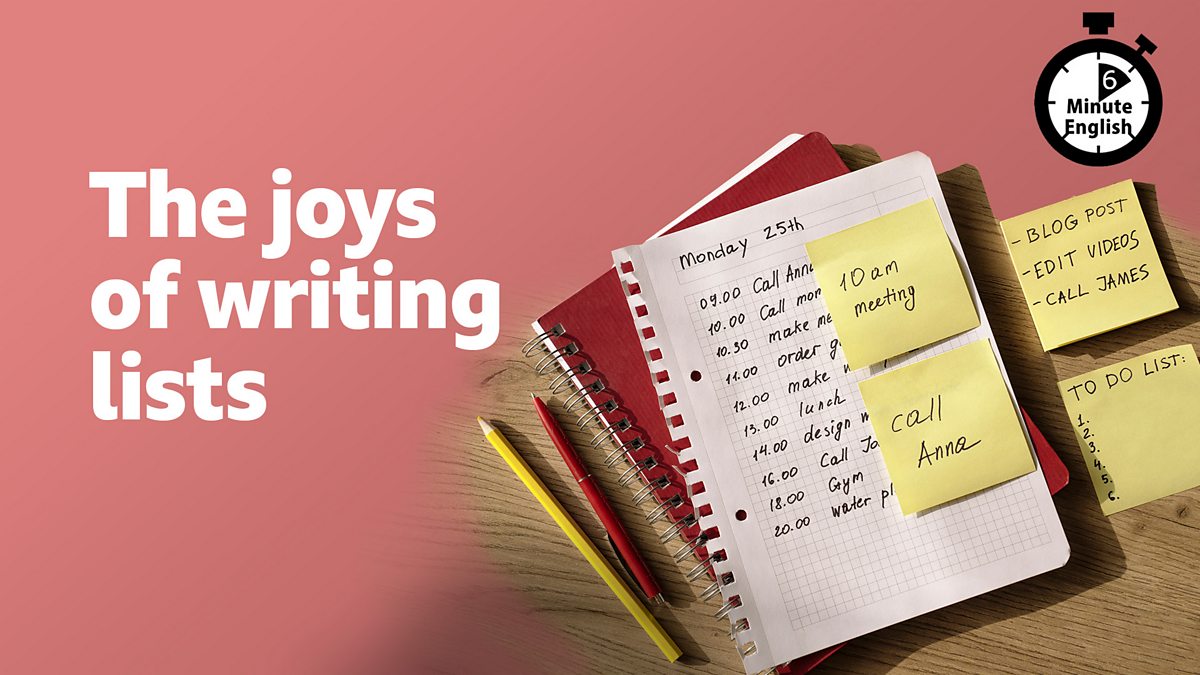
Hello. This is 6 Minute English from BBC Learning English. I'm Phil. BethAnd I'm Beth. PhilA list is a collection of items with a single item written on each line, and they're everywhere: shopping lists, to-do lists, even bucket lists a list of all the things a person would like to do before they die. In fact, there's an episode of 6 Minute English all about them*. BethImagine you're at the supermarket and find someone's shopping list. This happens a lot to Jo Nolan, a linguistics researcher whose new book explores our love of lists. Here's Jo reading her shopping list on BBC Radio 4 programme Word of Mouth: Jo NolanI only list the first four items, but the list read: "Nanas, aye-aye, puke, shrooms." Beth"Nanas, aye-aye, puke, shrooms." Err can you work out what Jo was buying at the supermarket, Phil? PhilOK. Well, I'm going to guess that 'nanas' are bananas. And 'shrooms' they've got to be mushrooms, right? BethOK. But what about 'aye-aye' and 'puke'? What could they mean? Well, here's Jo's explanation to Michael Rosen, presenter of BBC Radio 4's Word of Mouth:
And let's just come back to puke I mean, were you instructing yourself to be sick in the supermarket? I'm just a bit lost there. Jo NolanNo, it's slightly grotesque. Erm my husband doesn't like cucumber, and the abbreviation for cucumber would be 'cuc', so he has always referred to it as puke. PhilAha! Cucumbers make Joanna's husband puke a slang word for vomit. And puke rhymes with 'cuc', so it's a way of reminding her to buy cucumbers. Wow! Sometimes lists are like secret codes. ** BethIn this episode, we'll find out why people love lists and learn some useful new words and phrases. And remember: you'll find another list of all the vocabulary used on our website, bbclearningenglish.com. PhilBut first, a question for you, Beth. According to the list on the Internet Movie Database website, which movie has made the most money ever? Is it: a) Titanic,b) Avengers: Endgame, orc) Avatar? BethI think it might be Avatar, although that might have been the most expensive to make. I'm not sure. PhilOK. Well, we'll find out at the end of the programme. Popular songs are full of lists, and one of the most famous is My Favourite Things, sung by Julie Andrews in the film The Sound of Music. The song lists all her favourite things, from 'raindrops on roses' to 'whiskers on kittens'. Here, Jo Nolan and Michael Rosen discuss the song on BBC Radio 4 programme Word of Mouth: Jo NolanI feel like you get a lot you get a big bang for your buck in that song. Maybe it's the positivity it's a bit saccharine. Maybe that's also part of the issue. The list encourages you to think really efficiently and economically, so I think you don't waste a lot of time and effort making a nice sentence or using long words. You just get to the nub of things quite quickly. BethThe song's list of 'favourite things' is long, and Jo says you get a big bang for your buck an idiom meaning that you gain a lot in return for the money or effort you spend on something. But not everyone likes the song. Some call it saccharine an adjective meaning excessively sweet, sentimental or insincere. PhilLists often abbreviate the items they contain, so you get to the nub of things quickly. The nub of something means the most important or essential point about it. BethLists can be useful as well. Here's Jo Nolan giving an example of a useful list to BBC Radio 4's Word of Mouth: Jo NolanA friend of mine who makes pros and cons lists finds that it really helps her resolve a situation. She halves her page: pros, cons. And she said by the end of it, she knows what she's doing. PhilLists help us make decisions by writing down all the pros and cons of a situation. The pros and cons is another way of saying the advantages and disadvantages of something, especially when you're trying to choose between them. BethThe more you think about it, the more you see lists everywhere in menus and bank statements, for example. And therapists even recommend listing all the good things in your life to feel happier not bad for a few words on a scrap of paper. PhilOK. It's time to reveal the answer to my question. Beth, I asked you which movie had made the most money ever, and you said Avatar. And now, according to the Internet Movie Database that's exactly right.
Yay! PhilOK. Let's recap the vocabulary we've learned, starting with bucket list all the things you would like to do before you die. BethPuke is slang for vomit or sick. PhilIf something gives bang for your buck, you gain a lot of extra value in return for the money or effort you put into it. BethIf you call something saccharine, you criticise it for being too sweet or sentimental. PhilThe nub of a problem or situation is the most important or essential thing about it. BethAnd finally, something's pros and cons are its advantages and disadvantages. Once again, our six minutes are up, but remember you'll find a quiz and worksheet for this episode over on our website, bbclearningenglish.com. Goodbye for now! PhilBye! * Learn about bucket lists here: Are bucket lists always a good thing ** Later in the BBC World Service programme Word of Mouth, Jo Nolan explains that 'aye-aye' refers to broccoli, because during mealtimes her late father-in-law would often say to her children, "Aye-aye! Eat up your broccol-aye!"
Beth and Neil talk about a strange emotion we can feel at Christmas called nostalgia
Would you know how to spot a Death Cap mushroom?
Could your next therapist be a horse?
Have you ever tried a crisp sandwich?
Do you follow politics on social media?
What's the worst thing someone can do while eating?
Now try this...
Practise your skills with more lessons from 6 Minute English.
Gratis selamanya · Akses penuh
Go to full course →This lesson includes:
- 🎧Audio lesson
- 📄Downloadable PDF
- 📝Full transcript
- ♾️Full access — free forever
Takeaways
Podcast
6 Minute EnglishLatest 6 Minute English
6 Minute English / Scared of speaking English?
Episode 260122 / 22 Jan 2026
Beth and Pippa talk about why we often find speaking a new language scary.
6 Minute English / Can AI solve crime?
Episode 250417 / 17 Apr 2025
Could artificial intelligence be used to solve a murder?
6 Minute English / Learning multiple languages
Episode 250410 / 10 Apr 2025
Is learning languages good for you?
6 Minute English / Are we getting more allergic to things?
Episode 250403 / 03 Apr 2025
Do you know anyone who has 50+ allergies?
6 Minute English / The country that measures happiness
Episode 250306 / 06 Mar 2025
Is happiness the key to success?
6 Minute English / Becoming a musician
Episode 250130 / 30 Jan 2025
Hear about life as a professional musician

6 Minute English / Is rejection good for us?
Episode 260917 / 17 Sep 2026
How do you feel about being rejected?

6 Minute English / Can apps teach you a language?
Episode 260910 / 10 Sep 2026
What's better for learning languages – an app or a class?

6 Minute English / Climate change and extreme weather
Episode 260903 / 03 Sep 2026
Every year we see damage, death and destruction caused by hurricanes, cyclones and typhoons - tropical storms. Is climate change making this impact worse?

6 Minute English / How do we describe smells?
Episode 260827 / 27 Aug 2026
What is your favourite smell?