6 Minute English
medium level6 Minute English / What causes hearing loss?
Transcript
Note: This is a transcript of a spoken conversation and is not a word-for-word script.
Note: This is not a word-for-word transcript.
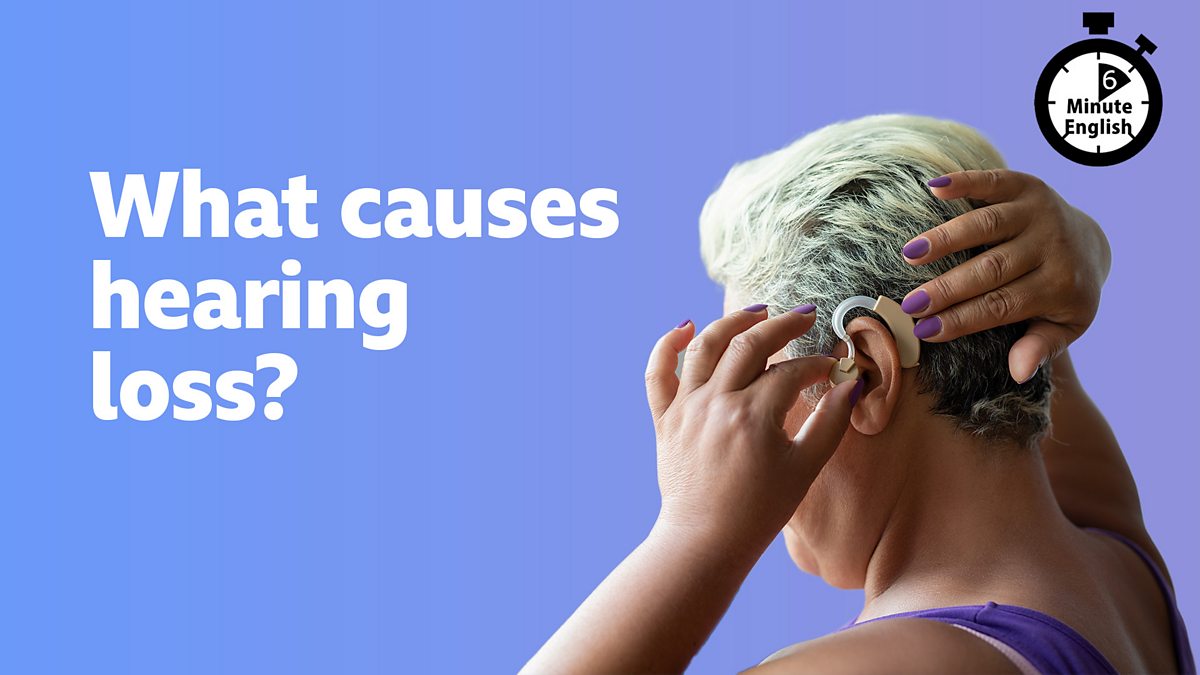
Hello, this is 6 Minute English from BBC Learning English. I'm Neil. GeorgieAnd I'm Georgie. As we get older, many of us notice our sense of hearing getting worse. Maybe we need to concentrate harder or ask people to speak more loudly. Has that happened to you, Neil? NeilNot really. A while ago I thought maybe my ears were getting worse, but I had a check-up and everything was fine, thankfully. GeorgieOh, that's great! In the UK alone, hearing loss affects 18 million people and that number is increasing. In this programme, we'll discover why we lose hearing with age and, as usual, learn some useful new vocabulary. NeilAnd you can also find a transcript of this episode on our website, bbclearningenglish.com. But now listen up, Georgie, because I have a question for you! Did you know that the three smallest bones in the human body the hammer, the anvil, and the stirrup are all located in the ear? But which one of those is the smallest? Is it: a) the hammer,b) the anvil, orc) the stirrup bone? GeorgieHmm. That one's a difficult one. I'm going to say the anvil bone. NeilOK. Well, we'll find out the answer later on. To understand why our hearing gets worse with age, it's useful to know a little about how the ear works in the first place. Here's Mr Nish Mehta, an ear, nose and throat surgeon at Royal National ENT Hospital in London, giving a beginners' class to BBC Radio 4 programme, Inside Health: Nish MehtaHearing is an amazing sense. It's a special sense, and the ear is really the hearing organ. So, the ear is split up into three main parts: there's the outer ear, the middle ear and the inner ear. The outer ear is the bit that you see it's on the side of your head. We call that the pinna. Think of that as the satellite dish. It collects the sounds and it funnels them in towards the sense organ. That then gets transmitted to the middle ear. The middle ear's main job is to amplify those sounds. That's done by having an eardrum, which catches it and then vibrates sympathetically to the vibration of the noise that you heard. And then that's passed on to the three smallest bones in the body: the hammer, the anvil and the stirrup. GeorgieThe ear is made up of outer, middle and inner parts. It's one of our sense organs: specific parts of the body your ears, eyes, tongue, nose and skin which allow you to experience the outside world. NeilThe visible part the outer ear or pinna acts like a satellite dish, collecting sounds which it funnels into the middle ear. The verb funnel means to move or direct something through a narrow space. GeorgieOnce in the middle ear, the eardrum amplifies the sounds before transmitting them to tiny hairs in the inner ear, which then sends electrical signals to the brain. It's an incredible system, but unfortunately one that can go wrong at any stage. Here, James Gallagher, presenter of BBC Radio 4's Inside Health, asks Nish Mehta when problems tend to start. James GallagherWe're going to spend a lot of today, Nish, thinking about age-related hearing loss. When does that start? Nish MehtaWear and tear of your hearing starts from around the age of eight. OK? James GallagherOK. So, we're doomed already! Nish MehtaWe're already on a downward spiral, but we've got a lot of redundancy in the system. And the speed at which our hearing declines is partly based on the genetics that you're born with and then partly based on the environment that you're exposed to. So, someone who has really strong genetics to protect them from hearing, but spends their life on a pneumatic drill, may have a much faster decline than someone on the other side. You can imagine that your brain is doing so much computation behind the scenes just to listen to someone speaking and understand the words they are saying. So, whilst hearing is going, the brain tends to increase its listening effort, and so often it's a very slow process for you to realise that you're struggling with hearing. NeilWear and tear of our hearing starts as young as eight. Wear and tear means the damage that comes from ordinary, everyday use. GeorgieWhen Nish says this, James exclaims, "We're doomed!" an informal way of saying we're destined to fail. From the age of eight our hearing is on a downward spiral a situation which gets worse and worse. NeilBut don't worry just yet! Human hearing has evolved with redundancy in the system a technical phrase meaning that there are many ways to achieve the same outcome so that a backup system can take over if other systems fail. Here, for example, the brain works harder to compensate for a weaker sound signal reaching the inner ear. GeorgieAnd there are other ways hearing loss can be helped as well, including hearing aids, surgery or even just removing extra ear wax not a job I would like very much! After that fascinating journey into the world of hearing, I think it's time to reveal the answer to your question, Neil. NeilI asked you, "Which is the smallest bone in the body?" and they are all in the ear. Is it a) the hammer, b) the anvil, or c) the stirrup bone? GeorgieI said the anvil, didn't I? NeilYou did, but I'm afraid you obviously weren't listening in Biology class because you are wrong. It is, in fact, the stirrup bone. GeorgieAh! NeilOK. Let's recap the vocabulary we've learned, starting with sense organs specific parts of the body, like your ears and eyes, which allow you to experience the world. GeorgieTo funnel means to move or direct something through a narrow space, and a funnel, the noun, is a cone-shaped tool which does this. NeilWear and tear refers to the damage that comes from using something every day. GeorgieIf you say, "We're doomed!" you mean we're going to be defeated or fail. NeilAnd a downward spiral is a situation which continuously gets worse and worse. GeorgieAnd finally, redundancy in the system refers to having more than one way to achieve an objective so that a backup can take over if other methods fail. You'll be sad to hear that, once again, our six minutes are up, but why not head over to our website, bbclearningenglish.com, to try the quiz and worksheet for this episode. Goodbye for now! NeilGoodbye!
Learn phrases with 'ear'.
Find an A-Z list of our programmes.
Beth and Neil talk about a strange emotion we can feel at Christmas called nostalgia
Would you know how to spot a Death Cap mushroom?
Could your next therapist be a horse?
Have you ever tried a crisp sandwich?
Do you follow politics on social media?
What's the worst thing someone can do while eating?
Now try this...
Practise your skills with more lessons from 6 Minute English.
Gratis selamanya · Akses penuh
Go to full course →This lesson includes:
- 🎧Audio lesson
- 📄Downloadable PDF
- 📝Full transcript
- ♾️Full access — free forever
Takeaways
Podcast
6 Minute EnglishLatest 6 Minute English
6 Minute English / Scared of speaking English?
Episode 260122 / 22 Jan 2026
Beth and Pippa talk about why we often find speaking a new language scary.

6 Minute English / Can AI solve crime?
Episode 250417 / 17 Apr 2025
Could artificial intelligence be used to solve a murder?

6 Minute English / Learning multiple languages
Episode 250410 / 10 Apr 2025
Is learning languages good for you?
6 Minute English / Are we getting more allergic to things?
Episode 250403 / 03 Apr 2025
Do you know anyone who has 50+ allergies?

6 Minute English / The country that measures happiness
Episode 250306 / 06 Mar 2025
Is happiness the key to success?

6 Minute English / Becoming a musician
Episode 250130 / 30 Jan 2025
Hear about life as a professional musician

6 Minute English / Is rejection good for us?
Episode 260917 / 17 Sep 2026
How do you feel about being rejected?

6 Minute English / Can apps teach you a language?
Episode 260910 / 10 Sep 2026
What's better for learning languages – an app or a class?

6 Minute English / Climate change and extreme weather
Episode 260903 / 03 Sep 2026
Every year we see damage, death and destruction caused by hurricanes, cyclones and typhoons - tropical storms. Is climate change making this impact worse?

6 Minute English / How do we describe smells?
Episode 260827 / 27 Aug 2026
What is your favourite smell?