6 Minute English
medium level6 Minute English / What makes a good citizen?
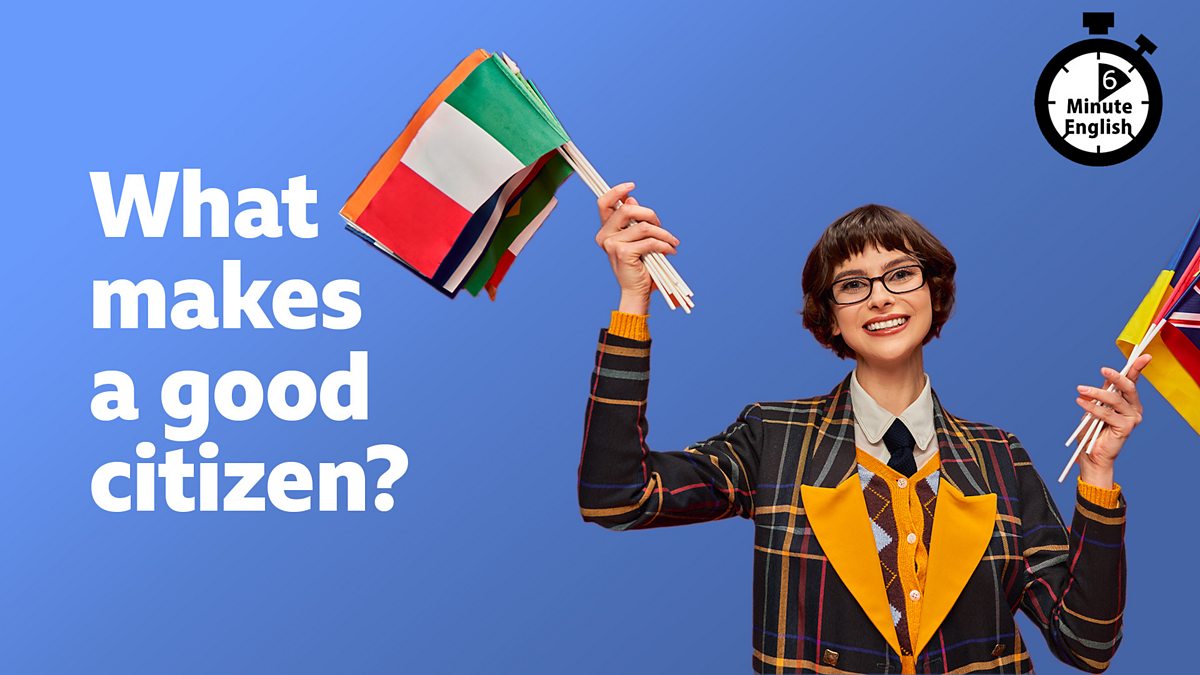
Transcript
Note: This is a transcript of a spoken conversation and is not a word-for-word script.
Note: This is not a word-for-word transcript.
Hello, this is 6 Minute English from BBC Learning English. I'm Neil. GeorgieAnd I'm Georgie. NeilGeorgie, what do you think makes a good citizen? GeorgieOoh, interesting question. I think a good citizen is someone who doesn't break the law and is generally kind to other people. What about you? Any ideas? NeilYeah, I agree. But also maybe people who volunteer so, people who run clubs for children and that kind of thing. I think they're good citizens. Now, being a citizen, a member of society who enjoys certain rights in return for having certain responsibilities, is an old idea that's been in the news a lot recently. It's something that interests Myra Anubi, presenter of BBC World Service programme People Fixing the World. Myra AnubiWhat do you think makes a good citizen? Is it someone who follows the laws of the land and pays their taxes? Well, some people might say it should go beyond that, and a good citizen is one who tries to improve the place where they live. GeorgieA good citizen obeys the law of the land a term for the set of rules and laws that exists in a country. But should there be more to it than that? NeilAround the world, young people today are less likely to vote, and many people aged 18 to 30 say they feel ignored by politicians. So, in this programme, we'll be hearing about MyPolis, an exciting project helping young people in Portugal re-engage with their citizenship. And, as usual, we'll be learning some useful new words and phrases, all of which you'll find on our website, bbclearningenglish.com. GeorgieBut before that, I have a question for you, Neil. The project's name, MyPolis, comes from the ancient Greek states, such as Athens and Sparta, where the idea of citizenship was born. So, what is the meaning of the Ancient Greek word 'polis'? Is it: a) vote,b) people, orc) city? NeilHmm, that's a good question. I'm going to guess b) people. GeorgieOK. Well, I'll reveal the correct answer later in the programme. MyPolis runs council assemblies where children can propose improvements to their local school community anything from fixing broken water fountains to changing the curriculum. Local politicians also attend, listening to the children's ideas and responding by giving their support or explaining why not. NeilThe project was started by founder Bernardo Goncalves when he was in his 20s, because he was disappointed by interactions between political parties and young people. Here's Bernardo telling more to BBC World Service programme People Fixing the World: Bernardo GoncalvesWe have seen a quick erosion in the trust of the population in the democratic institutions, such as the National Parliament, such as the government in office. We need to find new ways to connect children and young citizens to democratic institutions, otherwise the gap will get bigger and bigger. This is very dangerous for democracy. GeorgieBernardo thinks Portugal has seen an erosion of trust a term for the gradual weakening of people's confidence in political and economic institutions, and the government in office. A government in office means the government in power at the present time. NeilMyPolis mirrors the political activities that children will need as adult citizens things like voting and holding politicians accountable. Reporter Alison Roberts visited schools around the Portuguese capital Lisbon and was impressed by what she saw, as she explains here to Myra Anubi, presenter of BBC World Service's People Fixing the World: Alison RobertsAnother benefit is MyPolis has designed the programme so it can be included as part of the national curriculum, rather than as an add-on. Myra AnubiMmm. Well, it's good to know that this is happening in other places, but the thing that also really strikes me here is that politicians are actually listening to these kids and taking them seriously, giving them answers, because politicians, as we know, can be hard to pin down. GeorgieThe MyPolis programme is designed as part of the whole school curriculum and not just an add-on, meaning something extra that is added later, instead of being planned in from the start. NeilMyra was impressed that local politicians take the school children seriously. If you take someone or something seriously, youthink it's important and deserves attention. And that's good because, as everyone knows, politicians can be hard to pin down. To pin someone down means to force them to explain their plans and intentions in detail. GeorgieIt sounds like the programme is really developing active citizens of the future in Portugal. In fact, it's been so successful that similar programmes have been started in Italy, Hungary and Mozambique. OK. Neil, I think I should reveal the answer to my question. I asked you, "What is the meaning of the Ancient Greek word 'polis'?" And you said, "People," which was the wrong answer, I'm afraid. The right answer was c) city. NeilArgh, no! Right, it's time to recap the vocabulary we've learned, starting with the law of the land a term for the set of rules and laws that exists in a country. GeorgieAn erosion of trust happens when people gradually lose confidence in political and economic institutions. NeilIf a government is in office, it means they are currently in power. GeorgieAn add-on is an extra part that is added to something later, rather than being built in from the start. NeilIf you take someone seriously, you consider them important and worthy of your attention. GeorgieAnd finally, if you find it hard to pin someone down, it's difficult to find out their specific plans and intentions. Once again, our six minutes are up but remember you'll find a quiz and worksheet for this episode over on our website, bbclearningenglish.com. See you there soon. Bye! NeilGoodbye!
Learn more about language used in the news in Learning English from the News.
Find an A-Z list of our programmes.
Try The Reading Room.
Beth and Neil talk about a strange emotion we can feel at Christmas called nostalgia
Would you know how to spot a Death Cap mushroom?
Could your next therapist be a horse?
Have you ever tried a crisp sandwich?
Do you follow politics on social media?
Now try this...
Practise your skills with more lessons from 6 Minute English.
Gratis selamanya · Akses penuh
Go to full course →This lesson includes:
- 🎧Audio lesson
- 📄Downloadable PDF
- 📝Full transcript
- ♾️Full access — free forever
Takeaways
Podcast
6 Minute EnglishLatest 6 Minute English
6 Minute English / Scared of speaking English?
Episode 260122 / 22 Jan 2026
Beth and Pippa talk about why we often find speaking a new language scary.
6 Minute English / Can AI solve crime?
Episode 250417 / 17 Apr 2025
Could artificial intelligence be used to solve a murder?
6 Minute English / Learning multiple languages
Episode 250410 / 10 Apr 2025
Is learning languages good for you?
6 Minute English / Are we getting more allergic to things?
Episode 250403 / 03 Apr 2025
Do you know anyone who has 50+ allergies?
6 Minute English / The country that measures happiness
Episode 250306 / 06 Mar 2025
Is happiness the key to success?
6 Minute English / Becoming a musician
Episode 250130 / 30 Jan 2025
Hear about life as a professional musician

6 Minute English / Is rejection good for us?
Episode 260917 / 17 Sep 2026
How do you feel about being rejected?

6 Minute English / Can apps teach you a language?
Episode 260910 / 10 Sep 2026
What's better for learning languages – an app or a class?

6 Minute English / Climate change and extreme weather
Episode 260903 / 03 Sep 2026
Every year we see damage, death and destruction caused by hurricanes, cyclones and typhoons - tropical storms. Is climate change making this impact worse?

6 Minute English / How do we describe smells?
Episode 260827 / 27 Aug 2026
What is your favourite smell?